
Our Articles


Blog

Published on June 19, 2025
When your dryer stops working, it's frustrating. You've got wet clothes and growing laundry piles. The good news? Most dryer problems have straightforward causes. This guide walks you through 14 reasons why your dryer isn’t spinning from simple fixes you can try now or when it's time to call professionals.
If your dryer isn't doing anything; no lights, no sounds, no spinning; start here. Check these steps:-
Check your circuit breaker panel for a breaker labelled "dryer" that might be switched off or sitting halfway between on and off. If the breaker is off, flip it back on. If it trips again immediately, you have an electrical issue that requires a professional.
If you have a gas dryer, make sure the gas valve at the wall is turned on. Plug in a lamp in the same outlet to see if power reaches it. If the breaker keeps tripping, call a licensed electrician this is a safety issue.
The door latch switch is a small button near the door edge. Open and close the dryer door firmly and listen for a clicking sound. If you don't hear it, the latch might be broken.
Look inside the door frame for a small button or lever that should click when the door closes. If the button is cracked, loose, or doesn't click, replace the latch assembly. A broken door latch usually costs under $100 in parts and labor.
The thermal fuse is a safety device that cuts power if the dryer overheats. Once blown, it stays blown and can't be reset. The thermal fuse is usually a small cylinder near the blower wheel or exhaust duct.
Look at the wire inside. If the wire is broken or you see black burn marks, it's blown. A blown thermal fuse is very likely if your dryer hasn't been running. Thermal fuses blow when the dryer overheats, usually because the exhaust vent is clogged with lint.
Replacement usually costs $150 to $300 including labor. After replacement, clean your vent thoroughly to prevent recurrence.
If your dryer powers on but the drum won't start spinning, the problem might be the start button. Press the start button and listen for a clicking relay sound inside the dryer. If you hear the click but the drum doesn't turn, the motor or belt is the problem.
If you press start and hear nothing, the button itself may be faulty. A broken start button usually costs $100 to $200 to replace.
Your dryer lights up but nothing happens when you press start. Check the door latch first it's the most likely culprit. Make sure you're closing the door firmly.
Press and hold the start button for 3 to 5 seconds. Some dryers have a delay start feature check your settings to make sure it's not activated. If all these check out, the issue is likely a broken start button, blown thermal fuse, or failed control board.
Your dryer is running but the drum isn't turning. When the drum won't spin, something prevents the motor from rotating it.
The most common issue is with the drum belt. The drum belt wraps around the dryer drum and connects it to the motor. When the belt breaks, the drum spins freely but won't turn when the motor tries to drive it.
Open your dryer door and try to spin the drum by hand. If it spins easily with almost no resistance, the belt is definitely broken. A broken belt usually means the drum squeaked before stopping. You might also smell burning plastic.
The part costs $20 to $50, but labor adds $100 to $200. Many belts break because lint wraps around them. Regular maintenance prevents most belt failures.
The idler pulley keeps tension on the drum belt. When it breaks or seizes, the belt loses tension and the drum won't turn. If the drum is hard to spin by hand but the motor is running, the idler pulley is likely seized.
You'll often hear a high-pitched squeaking sound before the pulley fails. That squeaking is metal grinding as the pulley seizes a clear warning sign.
The drum rollers and bearing support the front of the drum as it spins. Over time, these wear out and can seize. If the drum is hard to turn or you hear squeaking or grinding, the rollers or bearings are probably worn.
Replacing them costs usually $200 to $400 with labor. This is more common in dryers that are 8 to 12 years old.
The motor drives the drum. If it burns out, nothing will turn the drum. If you press start and hear absolutely nothing, no humming, no clicking the motor might be dead. You might notice a burning smell before the motor fails. A new motor costs $300 to $600 with installation.
A continuously running dryer can overheat and create a fire hazard.
If your dryer continues to run even after the cycle ends, the timer is likely the culprit. Replacement usually costs $100 to $200.
If your dryer runs way longer than normal, the moisture sensor might be bad. Try cleaning it with a soft cloth and rubbing alcohol. A new sensor costs $100 to $200.
A stuck thermostat prevents the dryer from shutting off. Replacement costs $100 to $200.
If you've ruled out the timer, sensor, and thermostat, the control board is the next suspect. This usually costs $200 to $500.
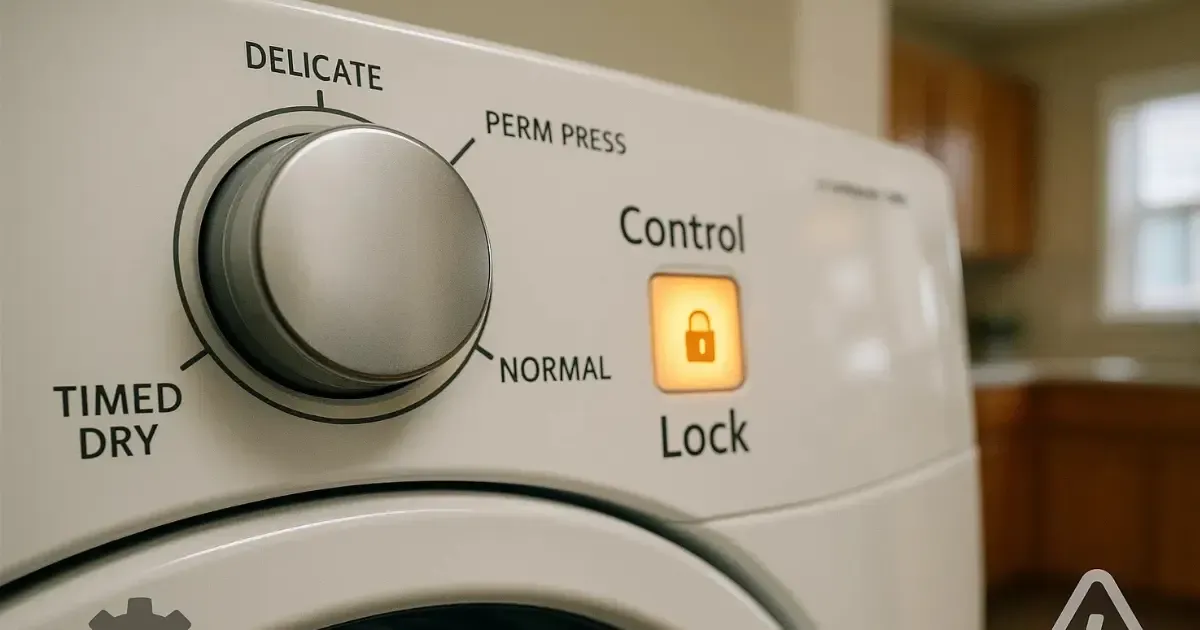
Try gently wiggling it back and forth. Check if debris is around the knob edge and clean it. If broken, replacement costs $50 to $150.
If the drum is hard to turn before a cycle, a drum roller, bearing, or idler pulley is probably failing. Address it soon before more damage happens.
Try applying penetrating oil around the knob edge. If it still won't budge, the timer might be seized. Replacement costs around $150 to $250.
Modern dryers often have a child safety feature called Control Lock that prevents accidental starts it's why your panel seems unresponsive even with power. You'll notice buttons do nothing, or a padlock icon lights up, stopping the drum from spinning.
To fix it yourself, simply hold the lock button (usually marked with a padlock symbol) for 3-5 seconds until it beeps or the light turns off; consult your model's manual for the exact button if unsure. This quick DIY reset takes seconds and costs nothing, but if it persists, the switch might need to be replaced by a professional.
If your dryer motor hums weakly but can't muster the torque to spin the drum, the start capacitor a small cylindrical part near the motor is often the culprit, as it provides the initial power boost for startup. Common in older or heavily used units, this failure mimics a seized motor, but with a slight buzzing sound rather than silence.
DIY testing requires unplugging the dryer, safely discharging the capacitor, and using a multimeter to check capacitance (typically 0.8-1.2 µF). Replace if readings are off, but it's rarely recommended due to electrical shock risks expect $100-250 for pro service, including parts.
Excessive lint buildup inside the dryer cabinet, beyond the obvious lint trap, can bind the drum and halt spinning by creating friction against moving parts like the belt or rollers. Symptoms include a burning smell from overheating, poor airflow even after vent cleaning, and a drum that feels sticky or resistant when turned by hand.
This isn't a DIY job, as it requires full panel removal to safely vacuum sealed areas without damaging wires or components professionals charge $100-200 for thorough cleaning, preventing fire hazards and extending dryer life.
High-pitched squeaking means friction from worn parts. The squeak gets louder as these parts wear, and eventually they fail completely. Addressing it now means a planned repair rather than an emergency breakdown.
A loud thump usually means something is hitting the drum. Stop using the dryer immediately. Remove the lint screen and look for debris. Reach carefully into the drum and feel for any stuck objects, such as coins or bobby pins.
A grinding or scraping noise usually comes from worn drum rollers or a bad bearing. This is usually a $200 to $400 repair.
If you hear the motor humming but the drum isn't moving, you've got a broken belt or failed idler pulley. Both are under $300 to fix.
Samsung dryers have a reputation for control board issues. Check the door latch and thermal fuse first. If those are fine, Samsung dryers often have faulty moisture sensors, which prevent the dryer from starting.
A control board replacement costs $200 to $400, while a moisture sensor is usually $100 to $150.
Whirlpool dryer is generally reliable, but they have two common problem areas: the thermal fuse and the idler pulley. The thermal fuse blows more frequently, especially if the vent gets clogged. Whirlpool parts are typically affordable.
LG dryers, especially newer sensor-dry models, often have control board and sensor issues. If your LG dryer has a "sensor dry" feature and won't start, the moisture sensor might be faulty.
Control board issues cost $250 to $500.
GE dryers are prone to failures of the drum roller and idler pulley. GE also has a higher failure rate for start buttons.
These brands have simpler designs. Most problems follow the same pattern: check the belt, idler pulley, and thermal fuse first.
If the repair costs more than 50% of a new dryer, replace it. A new basic dryer costs $400 to $600.
•0 to 5 years: Almost always repair.
•5 to 10 years: Repair if the cost is reasonable.
•10 to 15 years: Decision zone.
•15+ years: If major repair, replacement is smarter.
Is this the first time something's broken? Repair it. Have you fixed this dryer three times in two years? Time for a new one.
Newer dryers use 20% to 30% less energy. Older dryers use 5.0 to 6.0 kWh per load. Newer dryers use 3.5 to 4.5 kWh per load.
•Your dryer is under 10 years old.
•The repair is under $250 to $300
•This is the first major problem.
•You plan to use it for 3 to 5 more years.
•The part is common and affordable.
•Your dryer is over 12 years old.
•The repair is over $350 to $400.
•Multiple recent repairs.
•The failed part is expensive.
•You're planning to move or renovate soon.
I have described 14 reasons why your dryer isn’t spinning with simple fixes, but if you’re unable to fix it, call a professional appliance repair service.
Your dryer won't fix itself, and waiting makes repairs more expensive. If you're in the Sacramento area and want a professional diagnosis without the guesswork. We handle same-day and next-day repairs for most dryer issues.
We've fixed thousands of dryers. We charge honest prices with no hidden fees. We offer same-day and next-day service for most repairs. We're familiar with all the brands: Samsung, Whirlpool, LG, GE, Maytag, Kenmore, and others.
Call us at 916-333-8388 and describe what's happening. We'll listen and give you an honest assessment. We'll schedule a time that works for you. Most dryer repairs take 1 to 2 hours.
When we arrive, we'll do a full diagnostic and show you what we found. We'll give you a detailed quote before starting any work. No surprises. If you approve, we'll fix it usually the same day.
•Drum belt replacement.
•Idler pulley and drum roller repair.
•Thermal fuse replacement.
•Door latch repair.
•Start button and control board replacement.
•Lint vent cleaning.
•Moisture sensor replacement.
•Timer and thermostat repairs.
•Motor replacement and electrical troubleshooting.
A: This is usually the door latch switch, thermal fuse, or start button. Open and close the door firmly. If that doesn't work, the thermal fuse might be blown if your exhaust vent is clogged. A professional can diagnose this quickly and get your dryer running again.
A: The drum motor, drum belt, or idler pulley is the problem. Try spinning the drum by hand if it spins easily, the belt is broken. If it's hard to spin, the idler pulley or drum rollers are seized. These usually cost under $300 to fix.
A: Samsung dryers often have control board issues. Whirlpool usually has thermal fuse or idler pulley problems. LG frequently has sensor or control board issues. Start by checking the door latch, thermal fuse, and power on any brand.
A: A door latch is $100 to $150. A thermal fuse is $150 to $300. A start button is $100 to $200. A control board costs $200 to $500.
A: Some fixes are DIY-friendly. Replacing a thermal fuse or drum belt is possible if you're handy. But most people don't have the tools or confidence. If you're not sure, call a professional. It's usually faster and safer.
A: This usually means the door latch isn't registering, the thermal fuse is blown, or the start button is broken. The door latch is most likely make sure you're closing it firmly.
A: Stop using it immediately. A dryer running continuously can overheat and create a fire risk. The timer, moisture sensor, or control board is likely faulty. Call a professional right away.
A: No. Stop using it. A dryer making unusual noises is on the verge of failure. Something inside is breaking.
A: It depends on the repair cost and what broke. If it's a cheap repair, like a thermal fuse or a belt, under $200, fix it. If it's a motor or control board over $350, a new dryer might make sense.


