
Blog

Dishwasher Pump Problems in Sacramento: Symptoms, Diagnosis & Repair
If your dishwasher is leaving standing water at the bottom, making a grinding or humming noise, or stopping mid-cycle — the pump is usually the reason. Sacramento's hard water (8–10 grains per gallon) puts extra stress on dishwasher pumps compared to most California cities, which means local homeowners deal with pump failures more often and sooner than the national average.
This guide covers how to identify a failing dishwasher pump, what's actually causing the problem, when DIY makes sense, and what Sacramento pump repairs typically cost in 2025–2026.
Quick Answer: A dishwasher pump fails when mineral buildup, food debris, or a worn motor prevents water from circulating or draining. The most common signs are standing water after a cycle, loud humming or grinding during operation, and error codes like E24 (Bosch) or OE (Samsung). Most pump repairs in Sacramento cost between $130–$300 and take one to two hours.
TL;DR
● Standing water + grinding noise = likely drain pump failure
● Dishes coming out dirty + weak spray = likely circulation pump failure
● Sacramento hard water accelerates pump wear — descaling every 30 days helps
● Fair Appliance Repair Service offers same-day dishwasher pump repair across Sacramento: (916) 333-8388
How a Dishwasher Pump Actually Works
Most homeowners don't realize their dishwasher has two separate pumps — and which one is failing makes a big difference in how it gets fixed.
Circulation Pump vs. Drain Pump — The Difference
The circulation pump runs during the wash and rinse cycles. It pulls water from the bottom of the tub and pushes it up through the spray arms, creating the pressure that actually cleans your dishes. When this pump weakens or fails, water sits in the tub but barely sprays — dishes come out greasy, spotted, or still dirty even after a full cycle.
The drain pump activates at the end of each cycle. Its only job is to push used water out through the drain hose and into your home's plumbing. When this pump fails, water has nowhere to go — it collects at the bottom of the tub and stays there.
A simple way to tell them apart:
● Fills and sprays but won't drain → drain pump problem
● Fills and drains but doesn't clean → circulation pump problem
How Sacramento's Hard Water Affects Both Pumps
Sacramento's municipal water supply measures between 8–10 grains per gallon of dissolved minerals — hard enough to leave visible scale inside pumps, on heating elements, and across spray arm nozzles over time.
Inside the pump housing, calcium and magnesium deposits slowly coat the impeller blades. This forces the motor to work harder to move the same volume of water. The result: motors burn out faster, seals crack earlier, and bearings wear down years ahead of schedule compared to households in soft-water cities.
Homes in East Sacramento, Carmichael, and Rancho Cordova — areas supplied by Sacramento River water — tend to see this mineral buildup most aggressively. Running a monthly descaling cycle with citric acid or white vinegar isn't optional in Sacramento; it's maintenance that directly extends pump life.
Warning Signs Your Dishwasher Pump Is Failing
Pump problems rarely happen without warning. Most dishwashers give clear signals days or even weeks before a complete failure — knowing what to look for saves you from a flooded kitchen floor or a full appliance replacement.
Standing Water at the Bottom After a Cycle
This is the most common and most obvious sign of a failing drain pump. After your dishwasher completes a full cycle, the bottom of the tub should be dry or nearly dry. If you're consistently finding an inch or more of cloudy water sitting there, the drain pump either can't generate enough pressure to push it out — or it has stopped working entirely.
Don't confuse this with a clogged filter. A dirty filter causes slow drainage; a failing pump causes no drainage at all.
Grinding, Humming, or Clicking Sounds During Operation
A healthy dishwasher runs with a steady, low hum. Any change in that sound is worth paying attention to.
● Grinding — usually means a foreign object (glass shard, fruit pit, small bone) is caught in the pump impeller
● High-pitched humming with no water movement — the motor is receiving power but the impeller is seized, often from heavy mineral buildup
● Clicking or rattling — loose debris circulating through the pump housing before it causes a jam
Sacramento homeowners with older Bosch or GE units often describe this humming sound first — and ignore it for weeks — before the pump stops working completely. If you hear it, investigate before the motor burns out.
Dishes Coming Out Dirty or Spotted
When the circulation pump is weakening, spray arm pressure drops. Water still moves through the system, but not with enough force to reach the upper rack effectively. The result is dishes that feel greasy, glasses with white mineral film, and food residue left on plates even after a heavy-duty cycle.
This symptom is frequently misdiagnosed as a detergent problem or a loading issue. If switching detergents and rearranging dishes doesn't help, the circulation pump is worth checking.
Error Codes — E24, OE, F2, F6, and What They Actually Mean
Modern dishwashers display error codes when sensors detect pump-related failures. Here are the most common ones Sacramento technicians see:
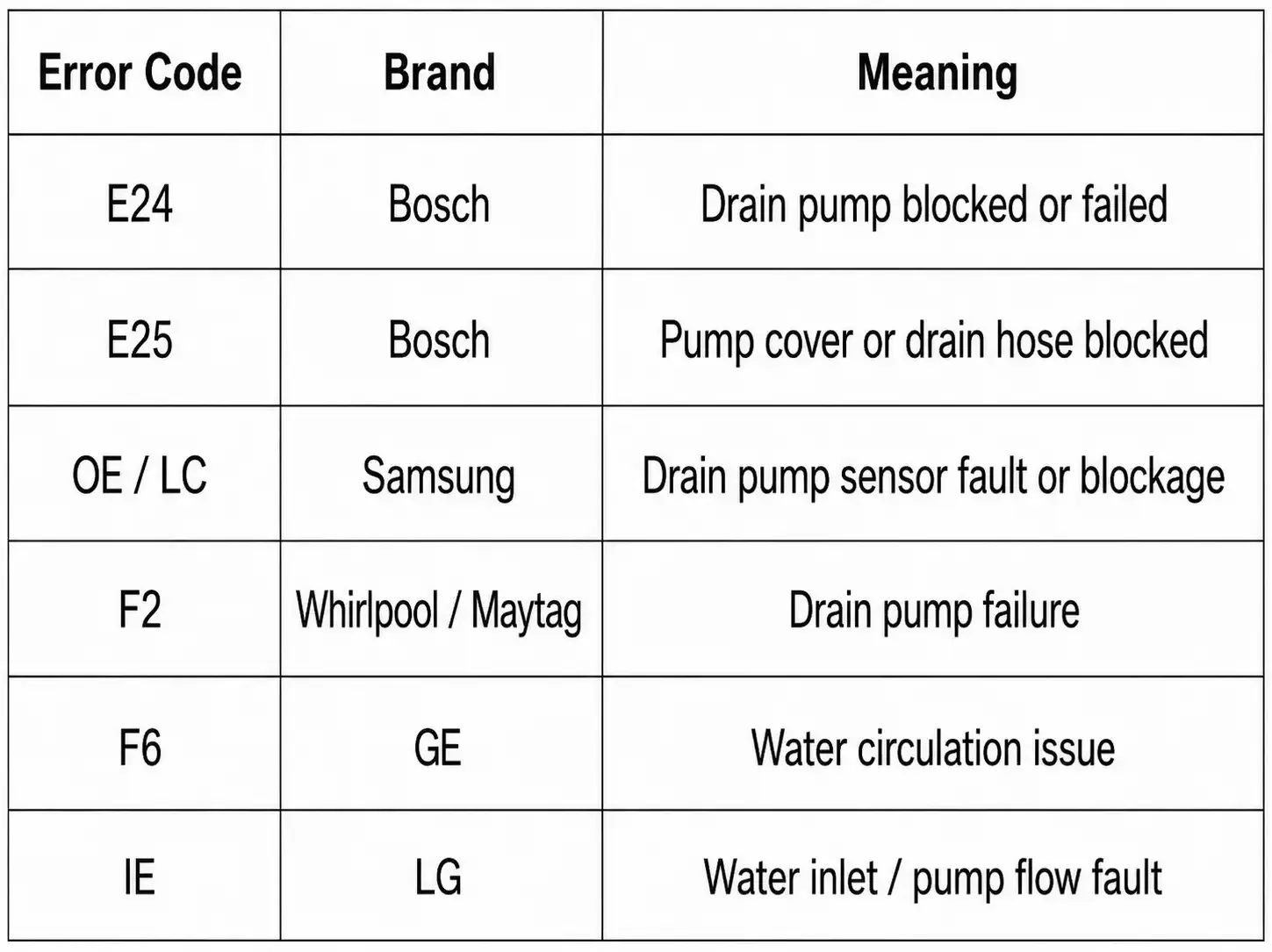
These codes don't always mean the pump itself is broken — sometimes it's a blocked hose or a dirty filter triggering the sensor. But they're the pump's way of telling you something is wrong and getting progressively worse.
Water Leaking from Under the Dishwasher
A pump with a cracked housing or worn seal will push water sideways instead of through the drain line. If you notice water pooling on the floor directly beneath the dishwasher — not from the door seal — the pump housing or its connecting hoses are likely the source.
Left unaddressed, this kind of leak causes water damage to cabinet bases, subfloor, and can create mold conditions within days in Sacramento's summer heat. It's one repair that should not wait.
Is It Really the Pump? How to Tell the Difference Between a Pump Failure and a Control Board Problem
This is the question Sacramento technicians get wrong the most — and it's the reason some homeowners pay for a pump replacement that doesn't fix anything.
The dishwasher's control board sends the electrical signal that tells the pump to turn on. If that signal never arrives — because of a faulty board, a blown fuse, or a bad wiring connection — the pump sits silent even though it's perfectly functional. From the outside, it looks identical to a dead pump: no drainage, no water movement, no response.
Replacing a pump when the real problem is the control board wastes $150–$300 and leaves you with the same broken dishwasher.
How to Tell Them Apart Before Calling a Technician
Signs pointing to the pump:
● You hear the motor trying to run (humming, buzzing) but water doesn't move
● The dishwasher completes other functions normally — filling, heating — but won't drain or spray
● Error codes specific to pump operation appear (E24, OE, F2)
● The dishwasher is 6+ years old and has never been descaled
Signs pointing to the control board:
● The dishwasher goes completely silent mid-cycle — no sounds at all
● Buttons on the panel respond inconsistently or don't respond at all
● The dishwasher randomly resets, cancels cycles, or behaves erratically
● Multiple functions fail at once, not just draining or spraying
●Error codes flash randomly across unrelated systems
The multimeter test is the definitive way to check. A functioning drain pump measures approximately 200 ohms of resistance across its terminals. A reading of zero or infinity confirms the pump motor has failed. If the pump reads normally but still won't run, the problem is upstream — the control board, wiring harness, or door latch switch.
Most homeowners don't have a multimeter or want to pull their dishwasher out to test it — which is completely reasonable. But understanding this distinction helps you ask the right questions when a technician arrives, and protects you from paying for the wrong repair.
At Fair Appliance Repair Service, every dishwasher diagnosis starts with electrical testing before any parts are recommended. The $0 diagnostic fee is waived with repair, so you're not paying to find out what's actually wrong.
The High Loop and Air Gap — Why Your Pump May Not Be the Problem
Here's something most dishwasher repair guides in Sacramento don't tell you: a significant number of "pump failures" aren't pump failures at all.
The drain hose that carries water out of your dishwasher needs to be routed correctly — either through a high loop or through an air gap device — to prevent backflow. When this setup fails or was never installed properly, dirty water from your sink drain can siphon back into the dishwasher tub. The result looks exactly like a pump problem: standing water, incomplete drainage, bad odors. The pump is working perfectly. The drain path isn't.
What a High Loop Is
A high loop means the drain hose is secured at the highest possible point under the sink — typically looped up and fastened near the top of the cabinet — before dropping down to connect to the garbage disposal or sink drain. Gravity prevents backflow as long as that high point exists.
If the hose has drooped down over time, lost its fastening clip, or was never properly installed, the loop disappears and backflow becomes possible.
What an Air Gap Is
An air gap is a small chrome or plastic fitting mounted on the countertop or sink deck next to the faucet. It creates a physical break in the drain line — water has to fall through open air before re-entering the drain pipe, which makes siphoning back into the dishwasher physically impossible.
California plumbing code requires an air gap or a properly installed high loop on all dishwasher installations. Many Sacramento homes — especially those with older kitchens or recent dishwasher swaps — have drain hoses that have shifted out of position without the homeowner realizing it.
How to Check Yours in Two Minutes
Open the cabinet under your kitchen sink. Find the corrugated drain hose coming from the dishwasher.
● If it connects directly to the disposal or drain without looping upward — that's the problem
● If it loops upward but the clip has come loose and the hose has sagged — refasten it to the cabinet wall as high as it will reach
● If there's an air gap fitting on the countertop — remove the cap and check for debris buildup inside, which is a common blockage point
If fixing the high loop or clearing the air gap resolves the standing water issue, you just saved yourself a pump repair bill. If water still sits in the tub after correcting the drain path, then the pump itself needs attention.
Does a Garbage Disposal Issue Look Like a Pump Failure?
If your dishwasher and garbage disposal share the same drain line — which is standard in most Sacramento kitchens — a problem with the disposal can create symptoms that look exactly like a dishwasher pump failure.
This is one of the most commonly missed diagnoses, and it sends homeowners down an expensive repair path unnecessarily.
The Knockout Plug Problem
When a new garbage disposal is installed, it comes with a knockout plug inside the dishwasher drain inlet. This plug must be removed before connecting the dishwasher drain hose. If a plumber or installer forgot this step — which happens more often than it should — the dishwasher drain hose has nowhere to push water. The pump runs, works correctly, but water backs up into the tub because the path is physically blocked
.
If your dishwasher suddenly stopped draining after a new garbage disposal was installed, check the knockout plug first.
Clogged Disposal = Backed-Up Dishwasher
Even with a properly installed disposal, a heavy grease clog or food blockage inside the disposal can prevent the dishwasher from draining. The dishwasher pump pushes water into the shared drain line, hits the blockage, and the water has nowhere to go but back into the tub.
Test this before assuming the pump is bad: run your garbage disposal for 30 seconds with cold water flowing, then immediately run a short dishwasher drain cycle. If the standing water clears, the disposal was the bottleneck — not the pump.
When the Disposal Connection Itself Is the Issue
The drain hose from the dishwasher connects directly to a port on the side of the garbage disposal. Over time in Sacramento homes, this connection point can:
● Crack from vibration or age, causing leaks that appear to come from the dishwasher pump area
● Accumulate grease buildup at the inlet, partially blocking drainage
● Come loose from the hose clamp, allowing water to leak under the sink
Before any pump replacement, a thorough inspection of this connection takes less than five minutes and can save a significant repair cost.
Quick Checklist Before Assuming Pump Failure
1: Run the garbage disposal — does the dishwasher then drain?
2: Was a new disposal recently installed? Check the knockout plug
3: Is there a leak at the hose connection to the disposal?
4: Does the disposal drain freely on its own when running water?
If any of these reveal the real problem, the dishwasher pump is fine. If all four check out and standing water remains, the pump is the next place to look.
Diagnosing Your Dishwasher Pump — Step by Step
Before calling a technician, these four checks take less than fifteen minutes and will tell you whether the pump is actually the problem — or whether something simpler is causing the symptoms.
Step 1 — Run a Drain-Only Cycle and Listen Carefully
Select the drain or cancel cycle on your dishwasher and stand next to it. Listen for what happens in the first 60 seconds.
● You hear a steady hum and water moves — the pump is working, look elsewhere
● You hear a hum but no water movement — the motor is running but the impeller is blocked or seized
● Complete silence — no power reaching the pump, possible control board or wiring issue
● Grinding or rattling sound — debris caught in the pump impeller
What you hear in this step alone narrows the diagnosis significantly before anything is opened or touched.
Step 2 — Clean the Filter and Check the Sump Area
Pull out the lower dish rack. Twist and remove the cylindrical filter at the bottom of the tub — in most dishwashers it turns counterclockwise. Rinse it under running water and use a soft brush to clear any buildup.
With the filter removed, shine a flashlight into the sump area below. Look for:
● Glass shards, fruit pits, or small bones sitting near the pump inlet
● Heavy brown or white mineral scale coating the sump walls
● Standing water that isn't moving even with the filter clear
In Sacramento homes where the filter hasn't been cleaned in months, this step alone resolves the drainage issue more often than any other fix.
Step 3 — Inspect the Drain Hose High Loop
Open the cabinet under the kitchen sink while the dishwasher is running a drain cycle. Watch the drain hose where it connects to the garbage disposal or sink drain.
● Is the hose looped up high before dropping to the connection point?
● Is the hose kinked, pinched, or crushed against the cabinet wall?
● Is there water dripping from the connection point at the disposal?
A kinked hose restricts flow enough to mimic a failing pump. Straighten it, rerun the drain cycle, and check whether drainage improves.
Step 4 — The Towel Test for Leaks
Place several dry paper towels flat on the floor directly beneath the dishwasher. Run a short rinse cycle, then check the towels immediately after.
● Towels dry — no active leak from the pump housing or seals
● Towels damp near the center — pump housing crack or worn seal
● Towels damp near the sides — door gasket or hose connection leak, not the pump itself
This test helps you pinpoint where a leak originates before any panels are removed — and tells you whether the pump body itself is compromised or whether the problem is a hose or gasket that costs far less to replace.
Common Causes of Pump Failure in Sacramento Homes
Understanding why pumps fail in Sacramento specifically — not just generically — helps you prevent the next failure after a repair and get more years out of your appliance.
Mineral Buildup from Hard Water
This is the leading cause of premature pump failure in Sacramento, and it compounds every single cycle.
At 8–10 grains per gallon, Sacramento's water deposits calcium and magnesium inside the pump housing, on the impeller blades, and across the motor bearings with every wash. Over months, this layer thickens. The impeller has to work harder to spin through the buildup. The motor draws more current to compensate. Bearings wear faster under the added friction.
Homeowners who never descale their dishwasher typically see pump problems appear between years four and six. Those who run a monthly citric acid or white vinegar cycle regularly push that timeline out to eight or nine years — sometimes beyond.
Food Debris and Foreign Objects
The second most common cause — and the most preventable.
Rice grains, small bones, olive pits, broken toothpick pieces, and glass shards from a chipped dish all find their way into the pump impeller. A small piece of debris that passes through the filter can jam the impeller mid-cycle, causing the motor to overheat from trying to spin against resistance. One jammed cycle can burn out a motor that had years of life left.
Pre-rinsing isn't necessary — modern dishwashers are designed to handle food residue — but removing large food scraps and checking for broken dish pieces before loading protects the pump from debris that the filter isn't designed to catch.
Motor Burnout
Pump motors burn out for three reasons: age, overheating from debris jams, and voltage irregularities.
In Sacramento's older neighborhoods — Midtown, East Sacramento, Land Park — homes with aging electrical panels sometimes deliver inconsistent voltage to appliances. Repeated voltage spikes stress the pump motor's windings over time, shortening its lifespan well below the typical seven to ten year average.
A motor that hums loudly but won't turn the impeller has usually reached this point. At that stage, the motor isn't repairable — the pump assembly needs replacement.
Central Valley Heat and Summer Stress on Components
This is a Sacramento-specific factor that rarely appears in national dishwasher repair guides.
During Sacramento's summers, when temperatures regularly exceed 100°F for weeks at a time, kitchen temperatures rise significantly — especially in homes without central air or with kitchens facing west. Dishwashers running in consistently hot ambient conditions work harder to regulate internal temperatures during heated dry cycles.
Pump seals and gaskets made from rubber compounds degrade faster under sustained heat exposure. In Sacramento homes that run the dishwasher daily through summer, seal failures and minor leaks tend to appear in September and October — at the end of the hot season — as the cumulative stress shows up in weakened components.
Running the dishwasher during cooler parts of the day — early morning rather than after dinner on hot evenings — is a small habit that meaningfully reduces thermal stress on pump seals over the appliance's lifetime.
Brand-Specific Pump Issues We See Most in Sacramento
Different dishwasher brands fail in predictably different ways. Knowing your brand's common failure pattern helps you recognize problems earlier and have a more informed conversation with your technician.
Bosch — E24 Error and Drain Pump Noise
Bosch is the most commonly repaired brand at Fair Appliance Repair Service in Sacramento, and the E24 error code is the call we receive most often.
E24 means the dishwasher detected a drain pump blockage or failure. In most Sacramento cases, the root cause is mineral-caked impeller blades preventing the pump from reaching full speed — the sensor reads insufficient flow and shuts the cycle down. A thorough descaling followed by a drain pump inspection resolves this in the majority of cases. When the pump itself has failed, Bosch drain pump replacements typically run $150–$220 including labor.
E25 — a related code — usually points to the pump cover being blocked rather than the pump motor itself, and is often resolvable without parts replacement.
Samsung — OE and LC Sensor Errors
Samsung dishwashers use a leak sensor positioned at the base of the unit. When this sensor detects moisture — from a weeping pump seal, a loose hose connection, or actual standing water — it triggers an OE or LC error and locks the dishwasher out of operation as a safety measure.
The frustrating part: the sensor is sensitive enough that even minor condensation from a Sacramento summer morning can trigger a false LC error. Before assuming pump failure on a Samsung, dry the base tray completely, run a cycle, and see whether the error returns. If it does consistently, the pump seal or drain pump itself needs inspection.
GE — Circulation Pump Failure After Five to Six Years
GE dishwashers — including Profile and Cafe series models — have a known tendency toward circulation pump failure between years five and six in hard water environments. Sacramento's mineral content accelerates this timeline compared to the national average.
The symptom is gradual: dishes that used to come out clean start showing residue on the upper rack first, then progressively worsen as the circulation pump loses pressure. By the time most GE owners call for service, the pump is operating at roughly half capacity. Circulation pump replacement on GE units runs $180–$280 in Sacramento depending on the model.
Whirlpool, Maytag, and KitchenAid — Impeller Misalignment and Seal Leaks
These three brands share platform components across many model lines, so they share similar failure patterns. The most common pump issue is impeller misalignment — where the plastic impeller shifts on its shaft over time, causing an intermittent grinding noise and reduced spray pressure.
The second most common issue is a failing pump seal that causes slow drips under the unit. Because Whirlpool, Maytag, and KitchenAid seal repairs are straightforward compared to other brands, they tend to be among the most cost-effective fixes — typically $90–$170 for a seal replacement before the leak causes cabinet or floor damage.
LG — Smart Inverter Motor Faults
LG markets its direct drive inverter motor as a ten-year component, and in soft water regions it often lives up to that claim. In Sacramento, mineral buildup inside the motor housing shortens that timeline and creates a specific failure pattern: the motor runs intermittently, completing some cycles normally and failing silently on others with no error code displayed.
LG's IE error code — indicating a water flow fault — is the most common pump-adjacent code Sacramento technicians see on LG units. In most cases it traces back to the inlet valve rather than the pump itself, but when the smart inverter motor does fail outright, LG replacement motors are among the more expensive parts — $220–$350 for the motor assembly alone.
DIY Repair — What You Can Do and What You Shouldn't Touch
Not every dishwasher pump problem requires a technician. Some fixes are genuinely straightforward for a careful homeowner. Others look simple but carry real risks — to your appliance, your warranty, and your home's plumbing.
Safe DIY: What Sacramento Homeowners Can Handle
● Filter cleaning and sump inspection Removing and cleaning the dishwasher filter takes three minutes and no tools. Do this first, every time, before assuming anything mechanical has failed. In Sacramento homes with hard water, filters clog faster than the manufacturer's recommended cleaning schedule suggests — every two weeks is more realistic than monthly.
● High loop inspection and correction Checking and refastening the drain hose high loop under the sink requires nothing more than a zip tie or a cabinet clip. If the hose has drooped, securing it back to the highest point on the cabinet wall costs nothing and takes five minutes.
● Descaling the pump and interior Running a descaling cycle with citric acid dishwasher cleaner or two cups of white vinegar on the hottest wash cycle is safe, effective, and the single best thing a Sacramento homeowner can do to extend pump life. Do this monthly — not quarterly, not annually. Monthly.
● Clearing the air gap If your countertop has an air gap fitting, twist off the cap and clear any debris from inside the fitting with a small brush or toothpick. A blocked air gap restricts drainage and is completely fixable without tools.
● Checking and clearing the garbage disposal connection Running the disposal before a drain cycle, and visually inspecting the drain hose connection at the disposal for blockages or loose clamps, is safe to do yourself.
Stop Here: Why Opening the Pump Voids Your Warranty
Once you go beyond the filter and the drain hose — once you start removing the lower panel, accessing the pump housing, or disconnecting electrical connections — you move into territory that carries serious consequences.
● Manufacturer warranty: Most dishwasher warranties explicitly state that unauthorized disassembly of internal components voids coverage. A Bosch dishwasher with two years of warranty left becomes your full financial responsibility the moment the pump housing is opened by someone other than an authorized technician.
● Incorrect reassembly causes leaks: The pump housing, impeller cover, and drain connections use specific torque tolerances and gasket seating. Reassembled slightly wrong, they leak — sometimes immediately, sometimes after several cycles when the damage to your cabinet floor has already begun.
● Electrical risk: The pump motor connects directly to the control board wiring harness. Working on live or recently powered appliance wiring without proper training and testing equipment carries a genuine shock risk.
● The math rarely works out: A replacement drain pump part costs $50–$120. If the installation goes wrong and damages the pump housing, control board connector, or causes a water leak, a repair that a technician would have handled for $150–$220 all-in can turn into a $400–$600 problem — or a full appliance replacement.
The filter, the hose, the air gap, the descaling — those are yours to handle. Everything behind the lower access panel belongs to a technician.
Dishwasher Pump Repair Costs in Sacramento — 2025/2026 Pricing
Pump repair costs in Sacramento vary based on which pump has failed, the brand and model, and whether parts need to be ordered or are available same-day. The pricing below reflects what Fair Appliance Repair Service charges for the most common pump repairs across Sacramento and surrounding areas.
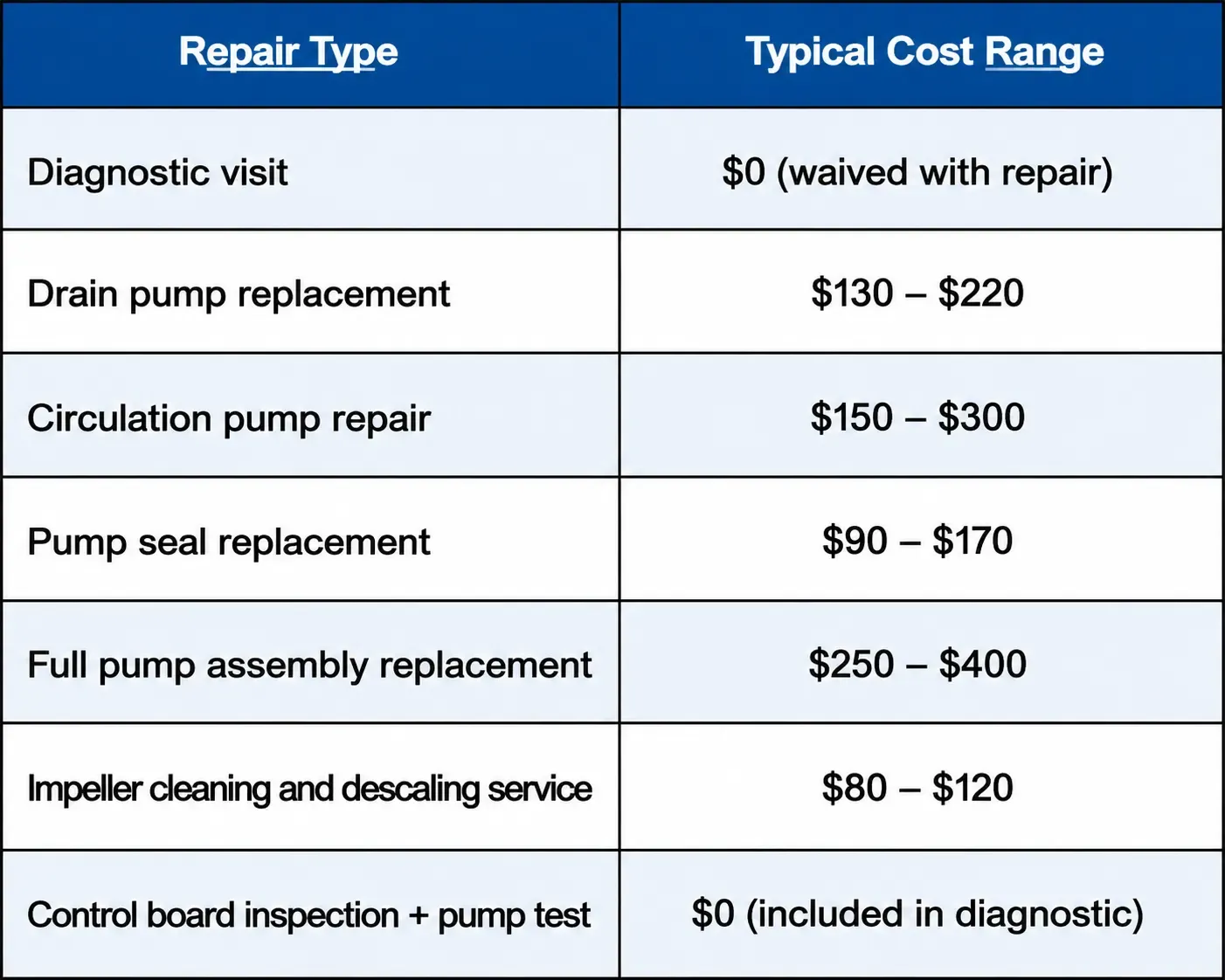
What Affects the Final Cost
● Brand and model — LG inverter motors and Bosch pump assemblies cost more in parts than Whirlpool or GE equivalents. Premium brands like Miele or Thermador carry significantly higher parts costs regardless of labor.
● Parts availability — Fair Appliance Repair Service carries OEM parts for Bosch, Whirlpool, Samsung, GE, LG, and Maytag on the service vehicle for most common repairs. Less common brands or older model years may require a parts order, adding one to three business days.
● Extent of damage — A pump caught early — humming but still partially functional — typically costs less to repair than one that has burned out completely after running seized for weeks. Early diagnosis saves money in nearly every case.
● Labor time — Most pump repairs take one to two hours on-site. Brands with more complex access panels — Bosch in particular requires removing the door liner on some models — add 30–45 minutes of labor compared to more accessible designs.
How Sacramento Repair Costs Compare to Replacement
A new mid-range dishwasher in Sacramento runs $600–$1,200 installed. A pump repair at $150–$300 makes clear financial sense on any unit under eight years old that is otherwise functioning normally. Where the math changes is when multiple components are failing simultaneously — if the pump, the door latch, and the heating element all need attention on a ten-year-old unit, replacement starts to make more economic sense than stacking repairs.
Fair Appliance Repair Service provides a transparent cost estimate before any work begins. There are no surprise charges, and the diagnostic fee is never charged if you decide not to proceed with the repair.
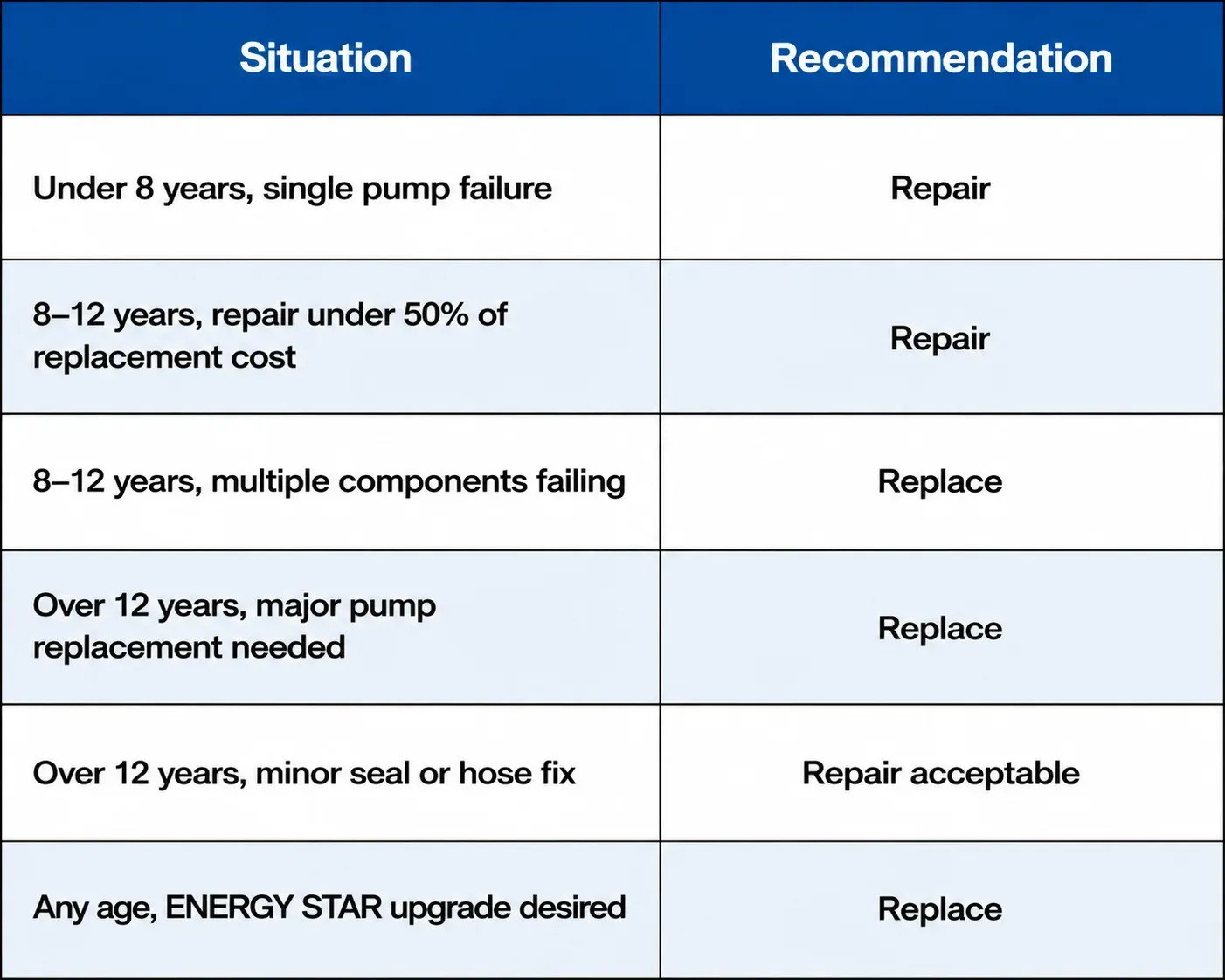
Repair vs. Replace — The 8–12 Year Rule
The most common question Sacramento homeowners ask after getting a pump repair estimate is whether it's worth fixing at all. The answer depends on a combination of the appliance's age, its overall condition, and what the repair actually costs relative to replacement.
The 8–12 year rule provides a practical framework for making this decision without guesswork.
Years 1–8: Repair Almost Always Makes Sense
A dishwasher under eight years old with a single pump failure is a strong repair candidate. The appliance has significant useful life remaining — most quality dishwashers last twelve to fifteen years with proper maintenance — and a $150–$300 pump repair delivers years of continued service at a fraction of replacement cost.
The exception is a unit that has already had multiple component failures in quick succession. A dishwasher that needed a new door latch last year, a heating element six months ago, and now a pump is showing a pattern of systemic decline regardless of age.
Years 8–12: Evaluate the Repair-to-Value Ratio
This is the zone where the decision requires more judgment. The appliance still has potential life left, but components are entering their natural wear window simultaneously.
Apply this test: if the repair cost exceeds 50% of what a comparable new dishwasher would cost installed, lean toward replacement. If it's below 50%, repair makes financial sense — especially if the unit is energy-efficient and fits your kitchen well.
For Sacramento homeowners in this range, it also factors in hard water wear. A dishwasher that has never been regularly descaled in a hard water environment ages faster internally than its calendar age suggests. A nine-year-old unit with heavy mineral damage throughout may be functionally closer to twelve years old in terms of remaining component life.
Years 12 and Beyond: Replace Unless the Repair Is Minor
Beyond twelve years, the economic case for major repairs weakens significantly. Pump replacement on a twelve-year-old dishwasher buys you an unknown amount of time before the next component fails — and replacement parts for older models become progressively harder to source.
The practical exception is a minor repair — a seal replacement, an impeller cleaning, a hose fix — that costs under $120 and restores full function. That level of investment on an older unit is reasonable. A full pump assembly replacement on a thirteen-year-old dishwasher generally is not.
Quick Decision Guide
Preventative Maintenance for Sacramento Homeowners
Most dishwasher pump failures in Sacramento are preventable. The homes where pumps consistently last ten or more years share one thing in common — a simple, consistent maintenance routine built around Sacramento's specific hard water conditions.
Monthly: Descaling for Hard Water Protection
This is the single most important maintenance step for any Sacramento dishwasher.
Once a month, run an empty dishwasher on the hottest wash cycle with one of the following:
●Citric acid dishwasher cleaner — the most effective option for dissolving calcium and magnesium deposits. Affresh, Finish Dishwasher Cleaner, and Lemi Shine are all widely available at Sacramento-area hardware and grocery stores
● White vinegar — place two cups in a dishwasher-safe bowl on the bottom rack, run a hot cycle. Less aggressive than citric acid but effective for routine maintenance between deeper descaling sessions
Do not mix vinegar and dishwasher detergent in the same cycle — the acid neutralizes the alkaline detergent and reduces the effectiveness of both.
For Sacramento homes with water hardness at the higher end of the 8–10 grain range — particularly in Elk Grove and Rancho Cordova where municipal supply fluctuates seasonally — descaling every three weeks rather than monthly extends pump life noticeably.
Every Two Weeks: Filter Cleaning
The manufacturer recommendation of monthly filter cleaning is too infrequent for Sacramento's hard water conditions. Every two weeks is the right interval here.
Remove the cylindrical filter, rinse it under warm running water, and use a soft-bristled brush to clear mineral buildup from the mesh. Pay attention to the flat mesh filter beneath it — this secondary screen catches fine debris and clogs quietly without obvious symptoms until drainage slows noticeably.
Reinstall both filters firmly. A loose filter allows debris to bypass the screen and reach the pump impeller directly.
Quarterly: Spray Arm Inspection and Clearing
Remove the upper and lower spray arms — they typically unscrew or pull straight off — and hold them up to light to check each nozzle hole. Clogged nozzles reduce circulation pressure and force the circulation pump to work harder to compensate.
Use a toothpick or thin wire to clear any blocked holes. Rinse the arms under running water before reinstalling.
Annual: High Loop and Drain Connection Inspection
Once a year, open the cabinet under the kitchen sink and check the drain hose setup.
● Confirm the high loop is still secured at its highest point — clips and zip ties loosen over time
● Check the hose connection at the garbage disposal for cracks, looseness, or grease buildup at the inlet
● Inspect the full length of the drain hose for kinks, pinch points, or wear spots near cabinet edges
This inspection takes five minutes and catches the drain path problems that mimic pump failure before they create bigger issues.
What to Avoid
● Overloading the dishwasher — forces the circulation pump to work against restricted water flow on every cycle
● Washing large food debris without pre-scraping — not full pre-rinsing, just removing bones, pits, and large scraps that the filter won't catch
● Using too much detergent — excess suds reduce pump efficiency and leave residue that accelerates mineral buildup
● Running the dishwasher with a damaged or missing filter — this sends debris directly to the pump on every cycle
Real Sacramento Case: Land Park Bosch Pump Fix
The following is a real repair completed by Fair Appliance Repair Service in the Land Park neighborhood of Sacramento — one of several hundred dishwasher pump calls we handle across the city each year.
The Call
A homeowner on 21st Avenue contacted us after their Bosch 500 Series dishwasher stopped draining mid-cycle and displayed an E24 error. The dishwasher was seven years old, had never been descaled, and the home was supplied by Sacramento municipal water — approximately 9 grains per gallon hardness.
The homeowner had already tried resetting the dishwasher multiple times and running a cancel cycle. Water remained sitting two inches deep in the bottom of the tub after every attempt.
What the Technician Found
On arrival, the technician ran a diagnostic cycle while listening at the door. The drain pump motor was audible — humming — but no water was moving through the drain line. This ruled out a control board issue immediately. The pump was receiving power and trying to run.
After removing the lower access panel and inspecting the pump assembly, the technician found the impeller heavily coated in calcium scale — enough buildup to reduce its effective diameter and prevent it from generating sufficient pressure to push water up through the drain hose.
The pump motor itself had not failed. The impeller was intact and undamaged. The problem was entirely mineral accumulation.
Secondary finding: the drain hose high loop had come partially loose from its cabinet clip, allowing a slight sag that was adding back pressure against the already-restricted pump. Neither issue alone would necessarily have caused a complete failure — together, they brought the system to a stop.
The Repair
● Full drain pump assembly cleaning and descaling — impeller cleared of mineral buildup, housing flushed
● Drain hose high loop refastened and secured at correct height
● Full diagnostic cycle run post-repair to confirm complete drainage and no recurrence of E24
Total repair time: 75 minutes. Total cost: $110 — below the threshold for a full pump replacement because the motor had not burned out.
The technician also ran the homeowner through a monthly descaling routine using Lemi Shine before leaving — a step that would have prevented the repair entirely if followed from installation.
What This Illustrates
Not every E24 error means a failed pump. Not every pump that stops working needs replacement. In Sacramento, where hard water is a constant variable, the majority of pump-related calls we handle involve mineral restriction rather than mechanical failure — and mineral restriction caught before motor burnout is significantly less expensive to resolve.
Early diagnosis, annual maintenance checks, and monthly descaling are what separate a $110 service call from a $250 pump replacement.
Why Choose Fair Appliance Repair Service in Sacramento
There are dozens of appliance repair companies operating in Sacramento. Here is what specifically distinguishes Fair Appliance Repair Service for dishwasher pump repairs.
Diagnosis Before Recommendation — Every Time
We don't replace parts before testing them. Every dishwasher pump call starts with electrical testing and a full diagnostic cycle to confirm which component has actually failed. You receive a clear explanation of what we found and what it will cost before any repair begins. If the pump tests fine and the real problem is a high loop or a garbage disposal connection, we tell you that — even though it means a smaller invoice.
Same-Day Service Across Sacramento
Fair Appliance Repair Service offers same-day dishwasher pump repairs six days a week across Sacramento and surrounding communities including Carmichael, Rancho Cordova, Elk Grove, Rosemont, and Citrus Heights. We cover ZIP codes 95814, 95819, 95825, and the broader Sacramento metro area.
Most pump repairs are completed in a single visit. Parts for Bosch, Samsung, GE, Whirlpool, LG, Maytag, and KitchenAid are carried on the service vehicle for the most common repair scenarios — no waiting a week for parts to arrive.
OEM Parts and a One-Year Warranty
Every pump replacement uses genuine OEM parts — not aftermarket components that may not meet the manufacturer's specifications for flow rate or thermal tolerance. All repairs carry a one-year warranty on both parts and labor. If the same issue returns within twelve months, we come back at no charge.
500+ Five-Star Reviews from Sacramento Homeowners
Fair Appliance Repair Service has earned more than 500 five-star reviews from Sacramento homeowners on Google, Yelp, and Nextdoor. The consistent feedback is straightforward: honest diagnosis, transparent pricing, repairs that hold.
We are locally owned and operated — not a national franchise with a call center in another state. When you call (916) 333-8388, you speak with a real person who schedules your appointment directly.
Licensed, Insured, and Accountable
Fair Appliance Repair Service is a fully licensed and insured appliance repair company operating out of Sacramento, CA 95835. Our BBB profile, Google Business listing, and Yelp page are all publicly verified. We carry liability insurance on every job — your home and appliances are protected throughout the repair process.
Ready to schedule?
Call (916) 333-8388 to speak directly with our team — or schedule online at farshomeservices.com/schedule. Same-day appointments available six days a week across Sacramento.
Fair Appliance Repair Service
341 Rick Heinrich Cir, Sacramento, CA 95835
📞 (916) 333-8388
Find Us On Google Maps: https://www.google.com/maps?cid=7027228233403408814
Frequently Asked Questions — Dishwasher Pump Repair in Sacramento
Q1. How do I know if my dishwasher pump is bad?
The clearest signs are standing water at the bottom of the tub after a cycle, a humming or grinding noise during operation with little or no water movement, dishes coming out dirty despite a full wash cycle, and error codes such as E24 (Bosch), OE (Samsung), or F2 (Whirlpool). If the dishwasher goes completely silent mid-cycle with no sounds at all, the issue may be the control board rather than the pump itself.
Q2. What causes dishwasher pump failure in Sacramento specifically?
Sacramento's hard water — measuring 8–10 grains per gallon — is the primary driver of premature pump failure locally. Mineral deposits coat the impeller and motor bearings over time, forcing the pump to work harder until it fails. Food debris reaching the pump impeller and Central Valley summer heat degrading rubber pump seals are the other leading causes specific to Sacramento homeowners.
Q3. What is the difference between a circulation pump and a drain pump?
The circulation pump runs during the wash cycle and pushes water through the spray arms to clean dishes. The drain pump activates at the end of each cycle to remove used water. If your dishwasher fills and sprays but won't drain, the drain pump has failed. If it fills and drains but dishes come out dirty, the circulation pump is the problem.
Q4. Could my garbage disposal be causing the dishwasher not to drain?
Yes — and this is one of the most commonly missed diagnoses. If the dishwasher drain hose connects to the garbage disposal, a blocked or malfunctioning disposal prevents the dishwasher from draining regardless of pump condition. Run the disposal for 30 seconds with cold water, then immediately run a dishwasher drain cycle. If water clears, the disposal was the bottleneck. Also check for a knockout plug if a new disposal was recently installed.
Q5. What is a dishwasher high loop and why does it matter?
A high loop means the drain hose is secured at the highest point under the sink before dropping to connect to the disposal or drain. This prevents dirty water from siphoning back into the dishwasher. If the high loop has sagged, water backs up into the tub after every cycle — mimicking pump failure. Refastening the drain hose to the top of the cabinet with a zip tie or clip resolves this at no cost.
Q6. How much does dishwasher pump repair cost in Sacramento?
Typical costs at Fair Appliance Repair Service range from $90–$170 for a pump seal replacement, $130–$220 for drain pump replacement, $150–$300 for circulation pump repair, and $250–$400 for a full pump assembly replacement. The diagnostic visit is free when you proceed with repair. All repairs include a one-year parts and labor warranty.
Q7. Is it worth repairing a dishwasher pump or should I replace the appliance?
For dishwashers under eight years old with a single pump failure, repair almost always makes financial sense. Between eight and twelve years, compare the repair cost against 50% of a replacement unit's installed price — if the repair is below that threshold, repair is the better choice. Beyond twelve years with a major pump failure, replacement is generally more economical.
Q8. How long does a dishwasher pump last in Sacramento?
With regular descaling and filter maintenance, a quality pump typically lasts eight to ten years in Sacramento's hard water conditions. Without maintenance, mineral buildup can shorten that lifespan to four to six years. Homes that run monthly descaling cycles consistently report pumps lasting ten or more years.
Q9. Can I replace a dishwasher pump myself?
Cleaning the filter, checking the high loop, and running descaling cycles are safe for homeowners. Replacing the pump itself involves removing access panels, disconnecting wiring harnesses, and working with sealed pump assemblies — and doing it incorrectly voids the manufacturer warranty and risks water damage from improper reinstallation. For pump replacement, professional service protects both the warranty and the repair outcome.
Q10. What does the E24 error code mean on a Bosch dishwasher?
E24 indicates the Bosch dishwasher detected a drain pump blockage or failure. In Sacramento, this most commonly results from mineral-caked impeller blades rather than a mechanically failed pump. A thorough descaling service resolves the majority of E24 errors without requiring pump replacement. E25 — a related code — typically points to the pump cover or drain hose being blocked rather than the pump motor itself.
Q11. Why does my dishwasher hum but not drain?
A humming sound with no water movement means the pump motor is receiving electrical power but the impeller cannot spin. This is most commonly caused by heavy mineral buildup seizing the impeller, a foreign object jammed in the pump, or a failed motor bearing. This symptom means the pump is receiving the correct signal from the control board — the failure is mechanical inside the pump itself.
Q12. How do I prevent dishwasher pump problems in Sacramento?
Run a citric acid or white vinegar descaling cycle every month, clean the filter every two weeks, inspect and clear spray arm nozzles quarterly, and check the drain hose high loop annually. These four steps directly address the leading causes of pump failure in Sacramento's hard water environment and extend pump life by three to five years on average.
Q13. Does Fair Appliance Repair Service offer same-day dishwasher pump repair?
Yes. Fair Appliance Repair Service offers same-day dishwasher pump repair six days a week across Sacramento, Carmichael, Rancho Cordova, Elk Grove, Rosemont, and Citrus Heights. Call (916) 333-8388 to check same-day availability for your ZIP code.
Q14. What brands does Fair Appliance Repair Service repair?
We repair all major dishwasher brands including Bosch, Samsung, GE, Whirlpool, LG, Maytag, KitchenAid, Frigidaire, Electrolux, Miele, Thermador, and Dacor. OEM parts for Bosch, Whirlpool, Samsung, GE, LG, and Maytag are carried on the service vehicle for most common repair scenarios.
Q15. What should I do while waiting for a technician to arrive?
Turn the dishwasher off at the control panel and switch off the circuit breaker if water is actively leaking onto the floor. Place dry towels around the base of the unit to absorb moisture. Do not run any further cycles — operating a dishwasher with a failing pump accelerates motor burnout and can turn a repairable pump into a full replacement. Leave the dishwasher door closed to contain any standing water in the tub.


