
Our Articles


Blog

Published on May 12, 2025
A clothes dryer is a marvel of convenience, but it is also one of the most energy-intensive and thermally volatile appliances in your home. When a dryer begins to run too hot, it isn’t just an inconvenience that shrinks your favorite sweater; it is a critical mechanical failure that places your property at risk.
In the Sacramento region, where summer temperatures frequently exceed 100°F, dryers often work in sweltering garages or tight laundry closets, making thermal regulation even more difficult. This guide explores why dryers lose their ability to control heat, how to identify the warning signs, and the steps you can take to fix your dryer overheating issue.
SAFETY WARNING: A dryer that runs excessively hot is a leading cause of residential fires. If you detect a burning odor, see smoke, or smell gas, power down the appliance and disconnect the supply immediately. Do not attempt internal repairs on a live electrical circuit. If you are uncomfortable working with 240V electricity or gas lines, contact a licensed professional.
• The Thermal Cycle: Effective drying relies on a precise balance of heat generation, airflow induction, and moisture extraction to keep internal temperatures stable.
• Warning Signs: Trust your senses—scorching cabinets, burning smells, and damp yet hot clothes are your appliance's primary distress signals.
• Primary Causes: Restricted airflow from lint buildup in the exhaust system remains the leading culprit behind thermal runaway and fire risks.
• The Sacramento Factor: Local triple-digit summer heat and sticky valley dust force dryers in garages to work significantly harder to maintain cooling.
• Brand-Specific Issues: Manufacturers design specific error codes, such as Samsung’s HE, to act as vital safety triggers when sensors detect dangerous heat levels.
• Gas vs. Electric: Regardless of whether your heat comes from a flame or a coil, both systems will fail dangerously if moist air is not continuously expelled.
• DIY Troubleshooting: A multimeter is your best tool for confirming that thermostats and elements are functioning correctly after you've safely disconnected the power.
• DIY vs. Professional: Handle basic vent maintenance yourself, but always defer to a licensed technician for complex control board or gas line repairs.
• Prevention Strategies: Guard your home by cleaning the lint trap with every load and scheduling a professional, deep-clean vent inspection every year.
To troubleshoot a machine that is running too hot, it helps to understand the delicate balance of physics happening inside the cabinet. A dryer doesn’t just "create heat"; it manages a constant exchange of energy.
• Generation: An electric heating element or a gas burner creates intense thermal energy.
• Induction: A blower wheel pulls fresh air across that heat source and pushes it into the drum.
• Extraction: As the air picks up moisture from your clothes, it must be immediately exhausted out of the house.
• Regulation: Sensors—known as thermostats or thermistors—constantly monitor the air. When the air hits a specific temperature, they cut power to the heater. When the air cools slightly, they turn it back on.
• The "Overheating" Event: Thermal runaway happens when this cycle is broken. Either the heat cannot escape (airflow issue), or the sensors have lost the ability to tell the heater to turn off (mechanical issue).
You don’t need a technician’s tools to spot a problem. Your senses are your best diagnostic equipment.
While a dryer will feel warm during operation, you should always be able to rest your hand on the top or side of the machine comfortably. If the metal cabinet feels painful to touch, the heat is being trapped inside rather than venting out.
If you select a "Delicate" or "Low Heat" cycle and your clothes emerge steaming or too hot to handle, the internal regulation has failed. This is a clear sign that the heating element is staying on longer than it should.
Modern dryers are equipped with a High-Limit Thermostat. This is a safety switch designed to kill power to the heater if it detects a dangerous temperature spike. If your dryer constantly stops before the timer is up, it is likely "tripping" this safety limit to prevent a fire.
A "hot" smell is common, but a "burning" smell is an emergency. This usually indicates that lint trapped inside the cabinet is beginning to singe, or the rubber drive belt is beginning to melt due to the ambient temperature inside the machine.
It sounds paradoxical, but a dryer that is "too hot" often takes longer to dry clothes. When airflow is restricted, the moisture stays trapped in the drum with the heat. You end up with a "sauna effect" where the clothes are hot and damp, rather than dry.
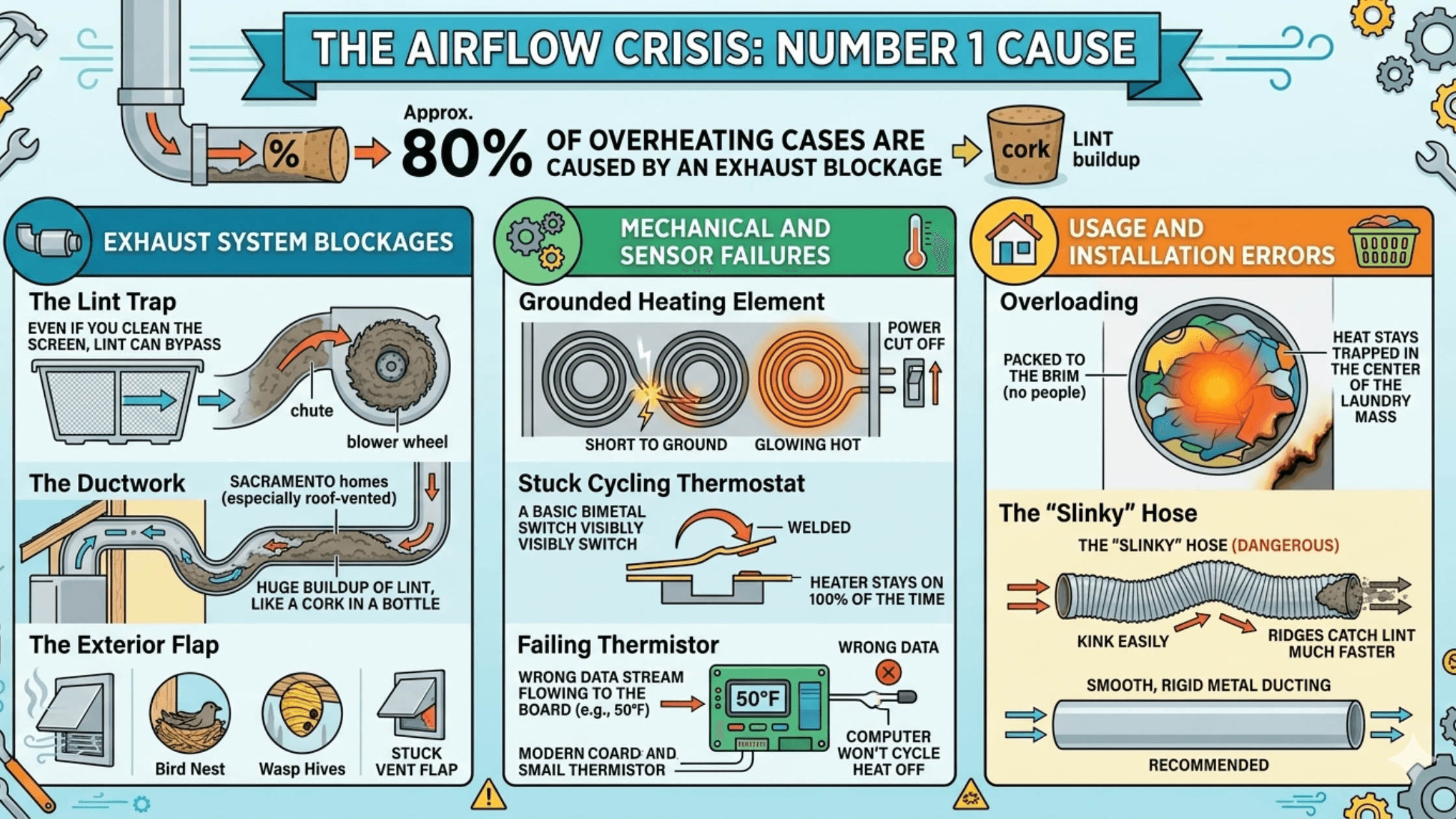
Approximately 80% of overheating cases are caused by a blockage in the exhaust system.
• The Lint Trap: Even if you clean the screen, lint can bypass the mesh and settle in the internal "chute" leading to the blower wheel.
• The Ductwork: Over years, lint coats the interior of your wall vents. In Sacramento homes with long vent runs (especially those that vent through the roof), this buildup acts like a cork in a bottle.
• The Exterior Flap: Bird nests, wasp hives, or even a stuck vent flap can prevent air from escaping.
If your vents are perfectly clean but the heat is still uncontrolled, the problem is internal:
Grounded Heating Element: In electric dryers, the coils can sag over time. If a coil touches the metal heater housing, it creates a "short to ground." This allows the element to stay glowing hot even when the thermostat tries to cut the power.
• Stuck Cycling Thermostat: This part acts like a light switch. If it "welds" shut, the heater stays on 100% of the time, regardless of the temperature.
• Failing Thermistor: In modern "smart" dryers, the thermistor sends data to the control board. If it sends the wrong data, the computer won't know to cycle the heat off.
• Overloading: Packing a dryer to the brim prevents air from circulating. The heat stays trapped in the center of the laundry mass, leading to scorched fabrics.
• The "Slinky" Hose: Using flexible plastic or thin foil "transition" hoses is dangerous. These hoses kink easily and the ridges inside catch lint much faster than smooth, rigid metal ducting.
Sacramento homeowners face specific challenges when it comes to appliance health.
• The Heat Index: During our triple-digit summers, a dryer located in a garage is already starting with an ambient temperature of 105°F or higher. The cooling system has to work twice as hard to move air.
• Dust and Pollen: Our valley is known for high particulate counts. This fine dust combines with laundry lint to create a thicker, "stickier" residue inside vents that can lead to faster blockages.
Different manufacturers display warning signs in different ways. Here are common issues based on your appliance brand:
If you own a Samsung, you might be asking, "What does he mean on a samsung dryer?" If your Samsung display flashes an HE or HC code, it indicates a thermal error.
This safety feature triggers when sensors detect temperatures that exceed safe operating limits. While a power reset might clear the code temporarily, the error will persist until the airflow restriction or faulty thermistor is addressed.
Whirlpool models are known for their robust safety features, but they are particularly sensitive to airflow restrictions. If your Whirlpool dryer gets too hot, the most common culprit is a blown thermal fuse triggered by a clogged exhaust vent.
When a thermal interruption occurs mid-cycle, the machine is designed to cut power to the heating circuit immediately. This safety power-off is a critical safeguard intended to prevent a lint fire.
If you find the machine’s cabinet is painful to the touch or notice a system shutdown before the clothes are dry, do not simply reset the breaker. Instead, use a multimeter to test the heating coils and thermostats for continuity, and perform a deep clean of the entire exhaust path from the drum to the exterior wall vent.
Maytag models share internal components with Whirlpool. If your Maytag dryer overheats and shuts off, it is frequently linked to a clogged internal lint screen housing or a failing cycling thermostat.
Can a dryer overheat? Yes, regardless of the power source.
Gas dryer getting too hot: Gas dryers use an open flame burner assembly. If the airflow is poor, the heat from that flame is trapped in the drum.
Electric dryer getting too hot: Electric models rely on metal coils that glow red hot. If the blower wheel fails or airflow is restricted, the ambient temperature skyrockets, resulting in a clothes dryer too hot for safe use.
If your dryer is overheating, stop using it immediately and perform the following diagnostic steps.
Safety is the priority. Unplug the dryer from the wall (or turn off the gas valve and unplug it). Depending on your model, you will need a screwdriver or nut driver to remove the back panel or the front bulkhead to access the internal components.
Remove the lint filter and use a long, flexible vacuum attachment to clean deep inside the filter housing. Next, disconnect the vent hose from the back of the dryer and the wall. Vacuum both ends.
Go outside and ensure the exterior vent flap opens freely. Pro Tip: If you are currently using a flexible, ribbed foil hose, throw it away. Upgrade to a smooth, rigid, or semi-rigid metal duct. Smooth metal reduces friction, drastically improves airflow, and is highly fire-resistant.
If the vents are clear, you must test the internal parts for electrical continuity. You will need a digital multimeter set to the lowest Ohms (RX1) setting or the continuity setting (the one that beeps).
• Testing the Thermostat: Locate the cycling and high-limit thermostats (usually oval-shaped modules mounted on the blower wheel housing or near the heating element). Remove the wires from the terminals.
Touch one multimeter probe to each terminal. A reading of zero (or a beep) means it has continuity. If it reads infinity (or OL), the part has failed and must be replaced.
• Testing the Thermistor: Thermistors must be tested for specific resistance at room temperature. Check your dryer's tech sheet (usually tucked inside the control panel) to find the correct Ohms rating (e.g., 10,000 Ohms at 77°F). If the reading is vastly different, replace it.
• Testing the Heating Element: Locate the heating element assembly. Test for continuity across the two main terminals. Then, touch one probe to a terminal and the other probe to the metal metal casing of the element. If you get a reading, the element is grounded (shorted) and must be replaced entirely.
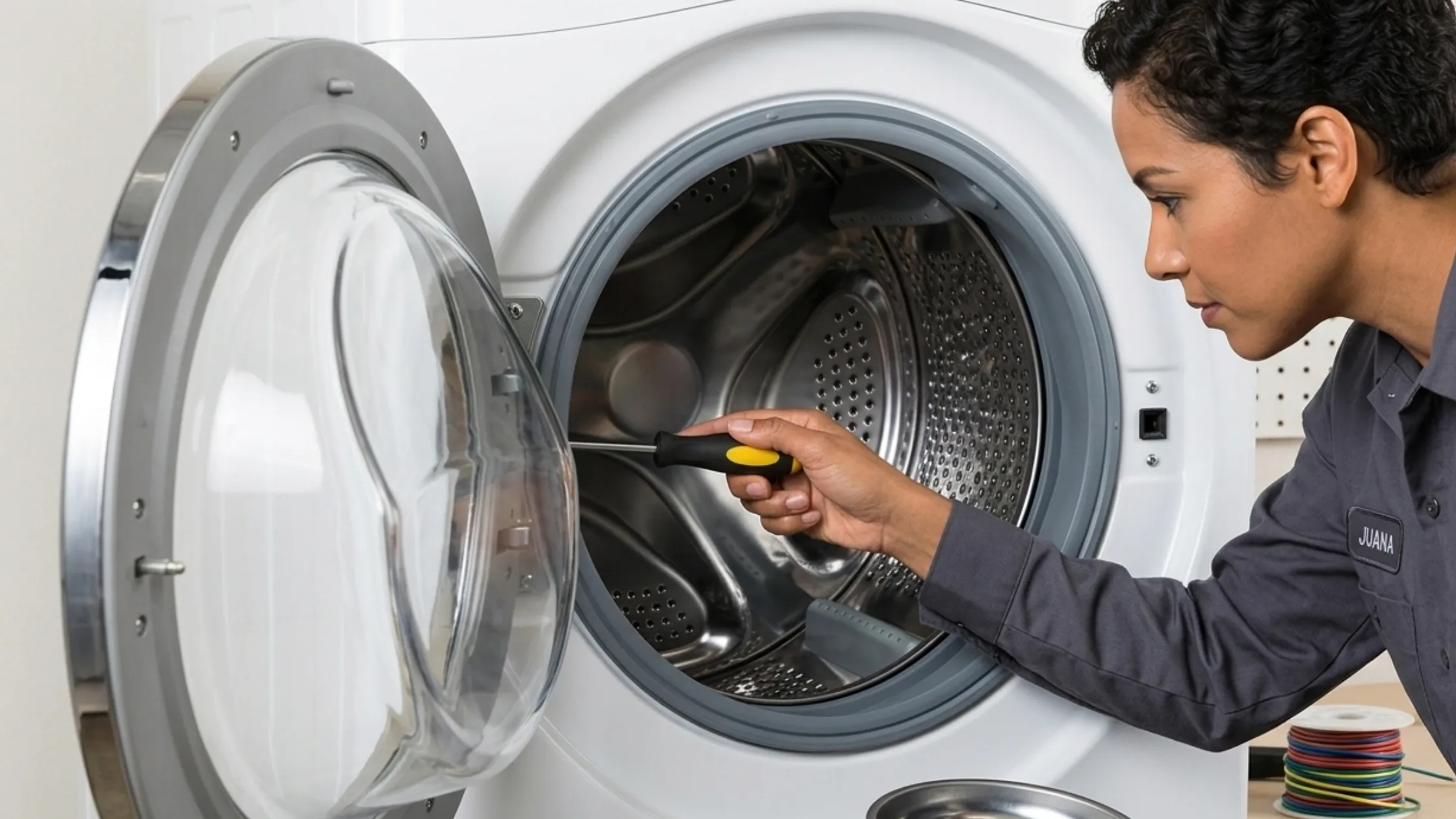
Cleaning vents, upgrading hoses, and replacing a basic thermostat are straightforward DIY tasks for homeowners comfortable with basic tools. However, you should call a professional appliance repair technician if:
• You are diagnosing a faulty main control board.
• The dryer is a gas model, and you suspect an issue with the gas burner assembly or gas valve coils.
• You do not own a multimeter or are uncomfortable disassembling the appliance cabinet.
• The dryer continues to overheat and shut off even after you have completely cleared the exhaust ventilation. If repair doesn't work, you need to purchase new dryer.
Preventing dryer overheating requires a mix of daily habits and scheduled maintenance.
• Load Management: Never fill the dryer drum more than 75% full. Clothes need room to expand and tumble. Additionally, separate heavy items (like towels and jeans) from lightweight items (like t-shirts). This ensures even drying and prevents the machine from running unnecessary extended heat cycles.
• Manage Oily Residues: If you are washing items heavily soiled with oil or grease, wash them twice with heavy-duty detergent, and strongly consider line-drying them to eliminate the risk of spontaneous combustion.
• Daily Maintenance: Clean the lint screen before every single load. Do not skip this step.
• Monthly Maintenance: Once a month, look behind the dryer to ensure the vent hose hasn't been crushed or pushed against the wall. Check the exterior vent to ensure birds or debris haven't blocked the opening.
• Annual Maintenance: Schedule a professional vent cleaning once a year. A professional service uses specialized rotary brushes and high-powered vacuums to clear lint from the entire length of your home's ductwork, which is especially critical if your dryer vents through the roof or over a long distance.
At Fair Appliance Repair Service, we don't just fix broken machines—we ensure your home is safe. Serving Sacramento, Elk Grove, Roseville, and the surrounding areas, our technicians specialize in deep-cleaning internal cabinets and testing safety thermostats to prevent fires before they start.
Don't ignore the warning signs. Call us at (916) 333-8388 or book your dryer repair service online today. We offer same-day appointments and a comprehensive warranty on every repair.
While dryer sheets don't directly heat the air, they can contribute to overheating by leaving a waxy residue on the lint screen and moisture sensors. Over time, this "invisible" film restricts airflow just as much as a layer of lint does. To check for this, run your lint screen under a faucet; if the water pools instead of passing through easily, you need to scrub the screen with a soft brush and warm, soapy water to restore proper ventilation.
Yes, ambient temperature plays a role in cooling and airflow. If your dryer is located in a small, unventilated closet or a scorching hot garage during a summer heatwave, the appliance cannot pull in enough "cool" air to regulate its internal temperature effectively. This forces the system to work harder and can lead to the thermal fuse tripping even if the vents are relatively clean. Ensuring the laundry room has adequate makeup air or keeping a door cracked can help.
Absolutely not. Using PVC pipe for dryer venting is a major fire code violation in most areas. PVC is prone to static electricity buildup, which attracts lint to the interior walls, leading to rapid clogs. More importantly, if a small fire starts within the lint, PVC will melt and release toxic fumes, whereas rigid metal ducting is designed to contain a fire long enough for the thermal sensors to react.
This is a classic sign of a "partial" airflow blockage or a failing blower wheel. When the blower wheel (the fan that pushes air out) is stripped or clogged with a stray sock, the heating element still gets hot, but the air is not moving through the drum. The heat sits stagnant, causing the exterior of the machine to feel like an oven while the moisture remains trapped inside the wet clothes.
A booster fan is a secondary fan installed in the middle of a long or complex vent run, typically those exceeding 25 feet or involving multiple 90-degree turns. If your dryer has to push air a long distance (such as up through a second story to a roof vent), the air loses velocity and drops lint. If you find your long vent run is constantly clogging and causing heat buildup, a booster fan can help maintain the necessary airflow speed.
While static is common in dry environments, excessive static electricity often indicates that the dryer is running too long and getting the clothes "too dry." This happens when moisture sensors are coated in fabric softener residue and fail to tell the machine to stop. This over-drying phase subjects the heating element to unnecessary wear and increases the risk of component failure due to sustained high temperatures.


