
Our Articles


Blog

Published on April 24, 2025
Have you noticed your gas stove or range producing orange or yellow flames instead of a steady blue? It’s more than just a cosmetic issue-it is a clear signal that your appliance is suffering from incomplete combustion. This is a potential safety hazard that wastes money and releases harmful byproducts into your kitchen.
We are proud to be your local specialists at Fair Appliance Repair Service when it comes to fixing things. From the iconic Tower Bridge in Sacramento to the bustling streets of Elk Grove, we consider you our neighbors and partners in ensuring home safety. We have helped more than 1,000 homes in the Sacramento Valley find and fix these harmful signals, making sure that families are safe. We promise to deliver our community-first approach right to your door.
This tutorial will help you fix your stove and explain why checking your oven and fridge is just as important for a safe and efficient kitchen. Imagine the Hendersons, a family in Elk Grove, who once faced the unsettling sight of a flickering orange flame. After a quick visit from our staff, they moved from fretting about the safety of their stove to enjoying the peace of a steady blue flame and a kitchen that is now a safe place to be. These real changes show why it's important to deal with orange flames right away.
A good gas flame should be bright blue with a clear, steady inner cone. Blue indicates:
✅ Complete Combustion: The fuel is burning as efficiently as possible.
✅ Safe Mixture: The amount of gas and oxygen in the air is just right.
✅ Clean Air: There aren't many byproducts, just water vapor and CO₂.
The fuel isn't burning all the way through if the flame is orange, yellow, or flickering. This lets out soot and carbon monoxide (CO), a gas that has no smell but is very dangerous. To keep you and your family safe, always check that your carbon monoxide detector is working. You should check your CO alarm as part of your regular kitchen cleaning.
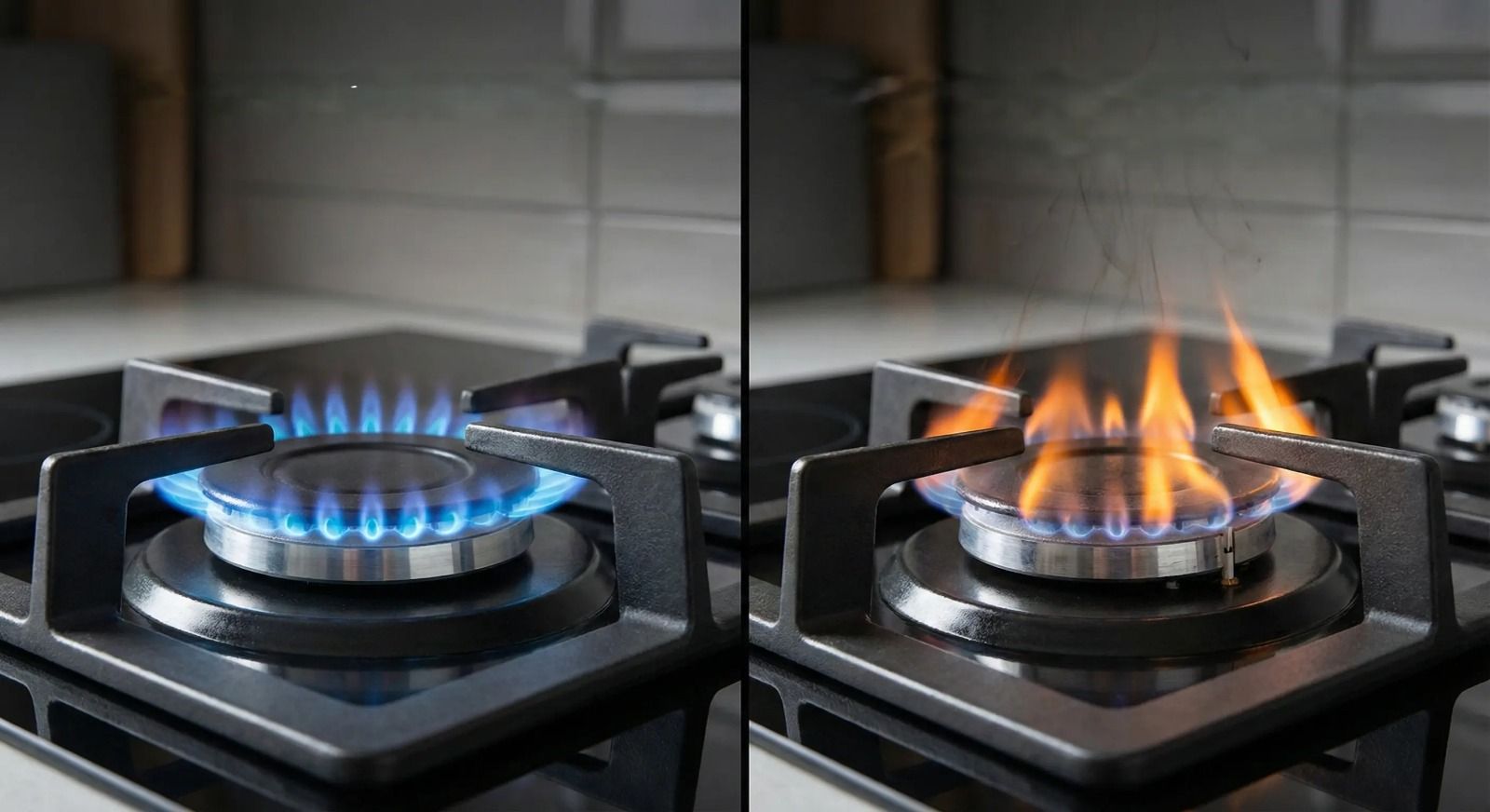
Before you panic, check the specific pattern of the flame.
If you see a mostly blue flame with occasional orange tips dancing at the top, this is often less critical. The orange color is usually caused by dust particles or air impurities burning off. If the orange disappears in under five minutes, it is safe. If it stays permanent, it needs cleaning. The orange color is usually caused by dust particles or air impurities burning off. If the orange disappears in under five minutes, it is safe. If it stays permanent, it needs cleaning.
✅ The Cause: This is usually caused by dust particles or air impurities (like those from a humidifier) burning off.
✅ The Verdict: If the orange disappears after a few minutes, it is safe. If it stays permanent, it needs cleaning.
A solid yellow flame (often called a "lazy flame") is dangerous. It indicates that the burner is starving for oxygen. This produces heavy soot (black powder) on your pots and high levels of Carbon Monoxide. Turn off the stove immediately.
Immediate Safety Checklist:
✅ Turn off the gas supply.
✅ Ventilate the room by opening windows and doors.
✅ Evacuate the area if you feel dizzy or lightheaded.
Acting quickly can prevent further danger and ensure everyone's safety in your home.
Over time, grease splatters and boiled-over food harden inside the tiny gas ports. This turbulence disrupts the smooth flow of gas.
Technician’s Warning: Do not use steel wool directly on the gas ports! It can break off inside or widen the holes, creating a jagged, unsafe flame. Use a soft nylon brush or a wooden toothpick.
If you are using Liquid Propane (LP) instead of natural gas, an orange flame often indicates the pressure is too high, or the orifice is incorrect.
The Fix: If you recently converted the stove, verify that the brass orifices were replaced with the smaller LP orifices. A natural gas orifice used on propane will release too much fuel, creating a large, dangerous orange flame.
To burn blue, your burner needs the right amount of oxygen. If the air shutter, which is normally a slotted plate behind the control knob, is blocked by lint or not lined up right, the flame will not get enough oxygen and will become yellow.
In the winter, humidifiers are often to blame. The flame burns the mineral and water particles in the air, which makes them orange for a short time.
Rust in the burner tubes can stop the gas from flowing. You can clean the outside, but rust on the inside usually means you have to replace parts.
1. Turn Off and Cool Down: Don't work on a hot burner for 5 minutes.
2. Ventilate: For three minutes, open the windows to let out any moisture.
3. Clean the burners by taking off the caps and soaking them in warm, soapy water. Gently scrub the base for around 10 minutes.
4. Free Ports: For about 5 minutes, use a brush or pin to carefully free any blockages.
5. Test: Put the burner back together and light it. Call a professional if the flame is still orange.
An orange flame is a sign that a kitchen needs maintenance. Since you are already looking at safety, it is time to check the rest of your kitchen's "vital signs."
Oven Repair Elk Grove
Just like your stovetop, your gas oven can suffer from combustion issues. However, inside an oven, this is more dangerous because the carbon monoxide is contained within the box before leaking into your home.
✅ The Warning Sign: If your oven takes 20+ minutes to preheat or you smell gas, you likely have a failing igniter.
If you are in the 95624 or 95757 zip codes, our oven repair Elk Grove team can calibrate your oven temperature and check for CO leaks in a single visit.
Refrigerator Repair Elk Grove
While your stove handles the heat, your refrigerator fights the ambient temperature. A stove emitting excess heat (due to inefficient orange flames) forces your fridge to work harder.
The Risk: If your fridge coils are dirty, the compressor overheats.
Technician’s Advice: We often see fridge failures in homes with poor ventilation. Our refrigerator repair Elk Grove service includes condenser coil cleaning to ensure your cold appliances aren't fighting your hot ones.
Appliance Repair Elk Grove, CA
Maintaining a home is about looking at the big picture. When you book a diagnostic for your stove, ask us about our Blue-Flame Assurance Visit. This comprehensive package provides peace of mind by ensuring your entire appliance setup is not just functional but optimized for safety and efficiency. We verify that all your gas and electric lines are up to code, safe, and efficient.
If your flame is still orange after cleaning, do not ignore it. Incomplete combustion releases invisible Carbon Monoxide and wastes your money every time you cook.
✅ Get it fixed today by Sacramento’s most trusted experts.
✅ Certified Technicians: We diagnose the real root cause (Propane mix, pressure, or ports).
✅ Local: Fast response in Elk Grove, Roseville, & Sacramento.
✅ Safe: We verify the safety of your entire kitchen before we leave.
Call 24/7: 916-333-8388
Is your kitchen safe? Learn why a gas stove orange flame indicates a carbon monoxide risk
A: If the flame is solid orange/yellow and you smell gas or sulfur (rotten eggs), leave the house and call the gas company immediately. If your appliance is just slightly orange and doesn't smell, call a repairman.
A: Not usually, but it's the main sign. A strong yellow/orange flame makes a lot of CO. A blue flame with a little bit of orange at the tips makes very little.
A: It means that the fire isn't burning completely, which is frequently caused by clogged burner ports, not enough oxygen (blocked air shutter), or high humidity in the house.
A: Use hot soapy water and a brush to clean the burner cap and ports. You might need a specialist to change the air shutter or regulator if the flame stays orange.
A: No, not usually. This is generally the result of dust or mist from a humidifier burning off. You can cook if the flame is predominantly blue and steady.
A: It is not a good idea. A small orange tip is fine, but a flame that stays orange or yellow all the time makes soot and carbon monoxide. If you keep using it, it might make your kitchenware dirty and the air within your home less clean.


