
Our Articles


Blog

Published on June 10, 2025
You open the dishwasher after a full cycle and your glasses are still cloudy. Your plates have white spots. Your coffee mugs look worse than before. Most people in Elk Grove assume it’s the dishwasher. The problem isn’t the dishwasher at all. It’s the detergent and the fact that Elk Grove has some of the hardest water in the Sacramento area.
We’ve repaired thousands of dishwashers across Elk Grove, and we see the same thing over and over: the wrong detergent for the wrong water. This dishwasher detergent guide for Elk Grove’s hard water will help you choose the right dishwasher detergent.
• The Elk Grove Water Problem: Why your dishes stay cloudy.
•The 5-Minute Test: How to Check Your Local Water Hardness.
•Pods, Powder, or Gel: Choosing the right formula for our area.
•The Rinse Aid Secret: Why detergent alone isn't enough.
•The Real Cost: A yearly breakdown of detergent pricing.
•Going Green: Eco-friendly options that actually work.
•Troubleshooting: Why won't the detergent dissolve?
Mechanical Red Flags: Signs the problem isn't your soap.
•Know When to Call Pro.
•FAQs: Answers to common Elk Grove dishwasher questions.
Before we talk about detergent, you need to understand one thing: not all water is the same.
Elk Grove’s tap water is hard. That means it carries high levels of dissolved minerals mostly calcium and magnesium come from the Sacramento County water supply and local groundwater sources.
When hard water mixes with the wrong detergent inside your dishwasher, those minerals don’t wash away. They leave a white, chalky film on your dishes. They cloud your glasses. They leave spots on everything. And no amount of re-washing will fix it because the water itself is the problem.
💧 Quick fact: Sacramento County water hardness averages around 138 mg/L well into the "hard water" category. Many Elk Grove homes run even harder depending on their specific zone.
You don’t need to call anyone or pay for a test. Just grab a water hardness test strip from Home Depot or Amazonthey cost around $10 for a pack. Dip one in your tap water, wait 30 seconds, and compare it to the color chart on the box.
If your reading comes back above 120 mg/L, you have hard water. And that means your detergent choice is about to matter a lot more than you thought.
Here’s where most guides get it wrong. They give you a generic comparison and call it a day. But what works in San Francisco’s soft water doesn’t work the same way in Elk Grove’s hard water. So let’s be specific.
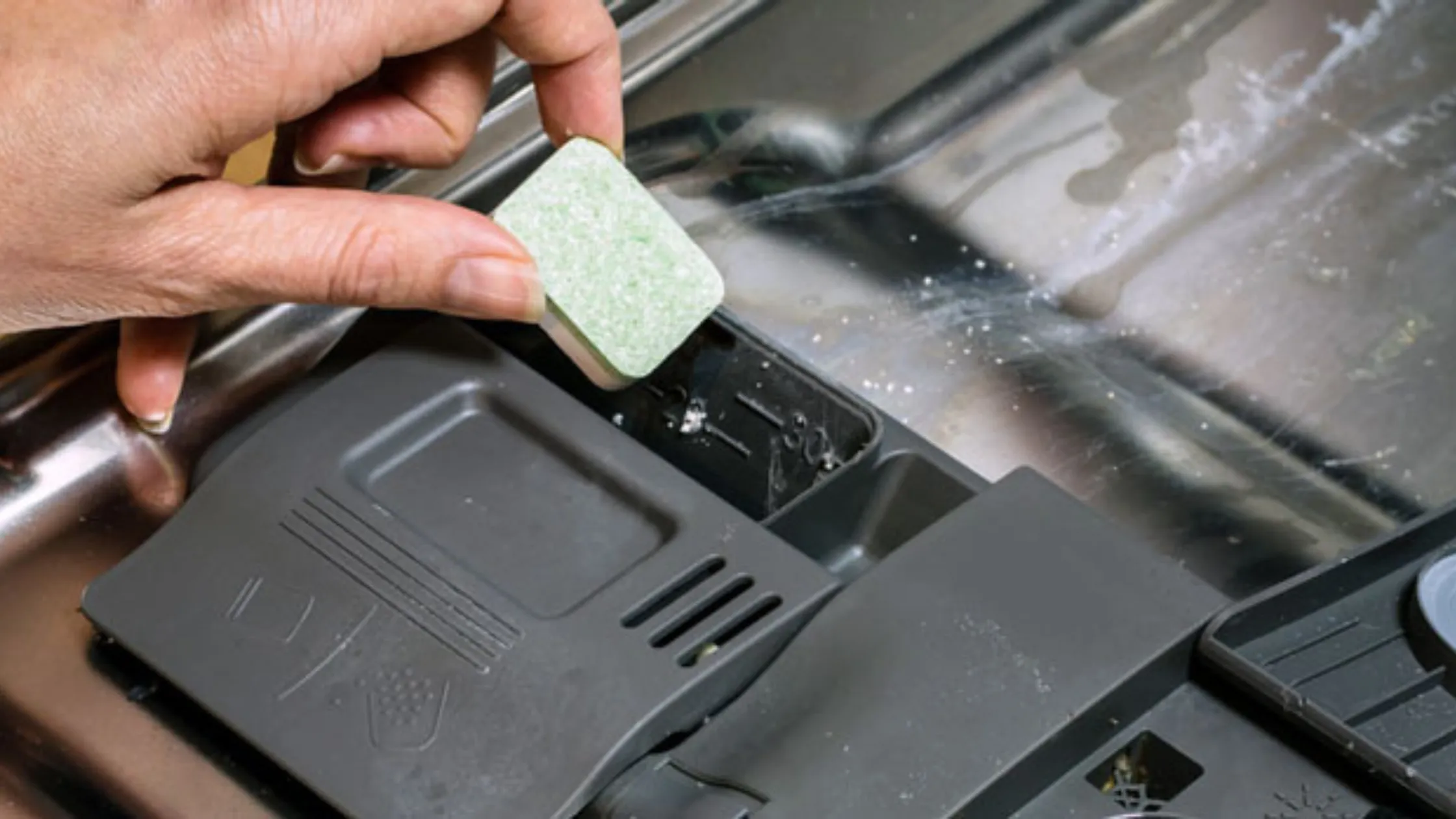
If you want the simplest answer: use pods. Premium dishwasher pods like Cascade Platinum or Finish Quantum are specifically engineered to fight the exact problem hard water creates. They come with a built-in water softening agent that breaks down mineral buildup before it can stick to your dishes.
You don’t have to measure anything. You don’t have to guess. You drop one in and go. For most Elk Grove homeowners running standard or heavy cycles, pods are the most reliable option.
One thing to note: pods cost more per load ($0.25 – $0.35) than the other options. But for most households, the consistency and results are worth it.
Powder detergent has a reputation for being old-fashioned, but it’s actually one of the smartest choices for hard water especially if you care about your glassware.
Many powder formulas are specifically designed to prevent spotting and streaking on clear glass. They’re also the most budget-friendly option by far ($0.08 – $0.15 per load), which adds up to real savings over a year.
The catch: powder doesn’t dissolve well in cold water. If you use it, always run a hot wash cycle (120°F or higher). And fill only to the marked line in the dispenser never overfill.
Recommended if you run full loads, use hot cycles, and want to save money without sacrificing clean dishes.
Gel dissolves fast, which sounds like a good thing, and it is for light loads and quick cycles, but gel has no built-in water softener, which means in Elk Grove’s hard water, it’s essentially fighting with one hand tied behind its back.
The result? More filming. More cloudiness. More of that frustrating white residue on everything.
Use gel only when you’re running a quick cycle with lightly soiled dishes. Stick to pods or powder for everyday washing in Elk Grove.
Even if you switch to the best pod on the market, you might still get cloudy glasses. Here’s the reason: detergent alone is not enough in hard water areas. You need rinse aid, too.
Rinse aid reduces water's surface tension, so it slides off your dishes in sheets rather than drying in droplets. Those droplets are what leave spots. In soft water areas, this is optional. In Elk Grove? It’s not optional. It’s essential.
✅ Fill your rinse aid dispenser once a month. If you’ve never used it before, find the small circular cap near the detergent dispenser inside your dishwasher door that’s where it goes.
• Cascade Platinum Pods + Finish Jet-Dry top-rated hard water combo, most consistent results.
• Finish Quantum Pods + Finish Jet-Dry excellent film prevention, same brand synergy.
• Seventh Generation Pods + Ecover Rinse Aid best if you prefer eco-friendly options.
Many Elk Grove homeowners use white vinegar as a DIY rinse aid. It does work in the short term the acidity cuts mineral buildup. However, here’s the problem- over time, vinegar degrades the rubber seals and gaskets inside your dishwasher, which can lead to leaks and costly repairs down the road.
Use it occasionally if you’re in a pinch. But don’t make it your everyday solution.
People always look at the price on the box. But that’s not the real cost. What matters is how much each load actually costs you.
An average Elk Grove family running one load per day:
• Pods / Tablets $0.25 to $0.35 per load, around $91 to $128 per year.
• Powder $0.08 to $0.15 per load, around $29 to $55 per year.
• Gel / Liquid $0.12 to $0.20 per load, around $44 to $73 per year.
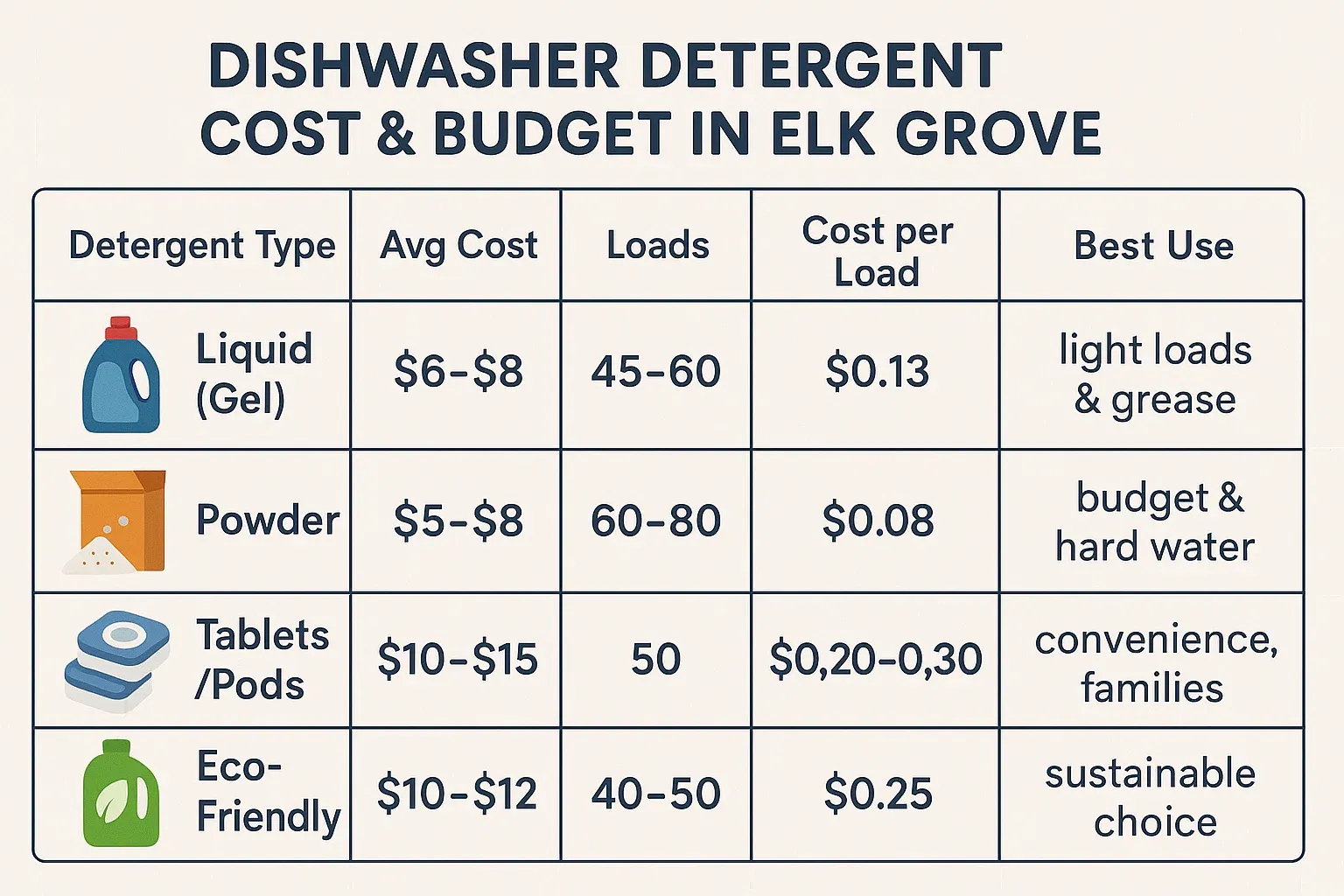
Powder is the clear winner in cost. If you’re consistent about using hot cycles and not overfilling the dispenser, powder can save you $60 to $100 per year compared to pods. That’s real money.
Eco-friendly dishwasher detergents have come a long way. The good news is that most mainstream dishwasher detergents in the U.S. are already phosphate-free that was phased out years ago. So you’re no longer choosing between eco-friendly and effective. You need to know what to look for.
• Enzyme-based formula as enzymes break down food soil naturally and work well even in hard water.
• Fragrance-free better for homes with allergies or sensitivities.
• Concentrated or refillable for less plastic waste, more value per dollar.
• Seventh Generation Free & Clear Pods : Enzyme-based, plant-derived, works in hard water.
• Ecover Automatic Dishwasher Tablets : Biodegradable, works in moderately hard water.
• Grove Co. Dishwasher Tablets : Zero plastic packaging, effective in hard water conditions.
One heads-up: Eco-friendly formulas often don’t include built-in rinse aid. In Elk Grove’s hard water, you’ll want to add a separate rinse aid to get spotless results.
Opening the dishwasher and finding the pod still intact, or a clump of powder stuck to the door that’s a specific kind of frustrating. Here’s what’s actually causing it:
Both pods and powder need hot water to dissolve properly. If your water heater is set too low, or your dishwasher’s heating element isn’t working right, the detergent sits there. A simple fix: run your kitchen faucet on hot for 30 seconds before starting the dishwasher. This gets hot water into the line from the start.
The detergent dispenser has a spring-loaded door that pops open during the wash cycle. If a tall pot, pan, or cutting board is blocking it, the door can’t open, and the pod never releases. Rearrange your loading so there’s always clear space in front of the dispenser.
If nothing is blocking the door and your water is hot, but you’re still finding undissolved detergent after every cycle, the dispenser spring or latch may be broken. This is a mechanical problem the dispenser door won’t open, no matter how good your detergent is. A technician can replace the dispenser quickly and affordably.
Powder detergent stored under the sink where it’s warm and humid will clump and fail to dissolve properly. Keep it sealed in a cool, dry spot. Pods left in a damp area can stick together or even start dissolving in the container before they ever reach your dishwasher.
We’ve been inside thousands of homes across Elk Grove and Sacramento. These are the mistakes we see constantly:
More is not better. Overfilling the dispenser especially with gel in hard water causes suds, residue, and that cloudy film on everything. Fill in the line. That’s it.
This is a big one. Hand dish soap creates excessive suds in a dishwasher and can overflow onto your floor. Always use detergent specifically made for automatic dishwashers.
In Elk Grove’s hard water, skipping rinse aid almost guarantees spotty, cloudy results. It’s not an optional extra here it’s a necessary part of the process.
Gel doesn’t have the hard-water-fighting power that pods and powder do. If your dishes are regularly coming out dirty or cloudy and you’re using gel, that’s your answer.
Heat and humidity are enemies of both powder and pods. Find a cool, dry shelf or cabinet away from the sink.
A dispenser that doesn’t open means your detergent never actually gets into the wash. It doesn’t matter if you’re using the best pod in the world if the dispenser is broken, your dishes will always come out dirty.
If you’ve switched detergents, started using rinse aid, adjusted your water temperature, rearranged your loading pattern and your dishes are still coming out cloudy, dirty, or spotted stop blaming the detergent.
At that point, the problem is the dishwasher itself.
• Dishes still greasy or dirty after a full cycle even with good detergent.
• Standing water sits at the bottom after the cycle ends.
• The dishwasher smells bad even right after running.
• You keep finding undissolved detergent or an intact pod after every cycle.
• The spray arms aren’t spinning, or the water pressure feels weak.
• The water doesn’t feel hot when you open the door mid-cycle.
• You’re hearing grinding, humming, or rattling sounds that it didn’t use to make.
A clogged spray arm looks exactly like a detergent problem the water can’t reach your dishes properly, so they come out dirty no matter what you put in the dispenser. A failing water inlet valve reduces the water pressure that your dishwasher needs to rinse effectively. A broken heating element means water stays lukewarm, and your detergent never fully activates or dissolves. These are all mechanical problems. No detergent on earth will fix them. But a professional appliance repair service can.
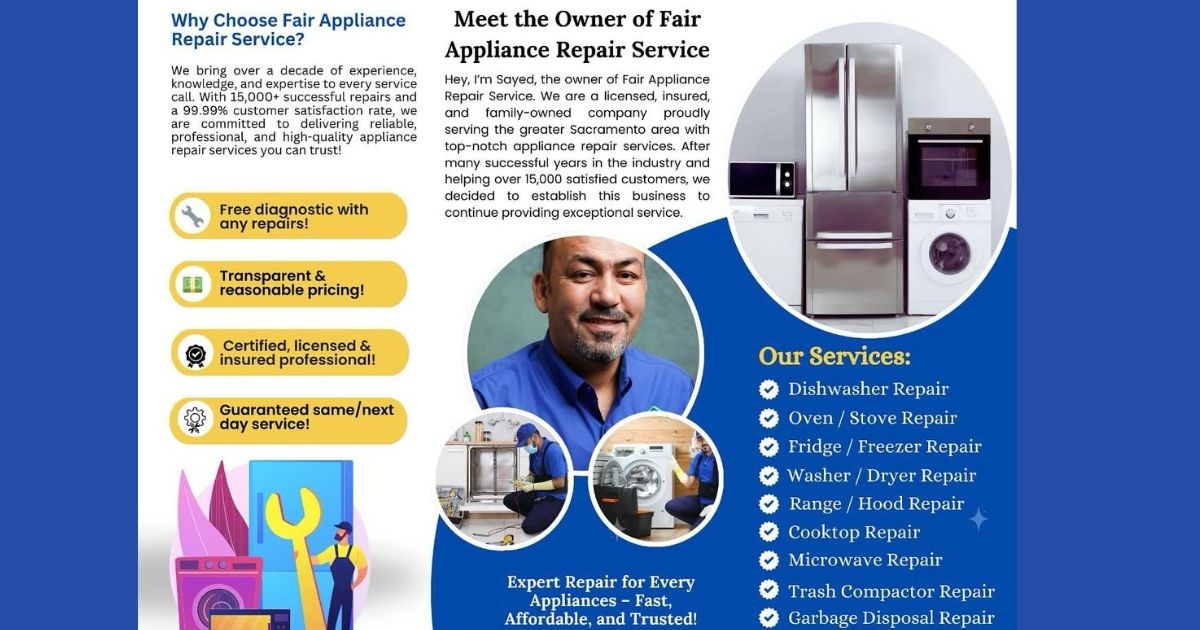
I hope this dishwasher detergent guide for Elk Grove’s hard water is informative for you. Still getting dirty dishes after switching detergents? Fair Appliance Repair Service offers same-day dishwasher diagnostics across Elk Grove (95757, 95758, 95624) and the greater Sacramento area since 2015. We will find the real problem fast. We’ve completed 4,000+ repairs across the Sacramento area, as we carry a BBB A+ rating, Google Verified status, and over 700 five-star reviews from real local customers.
We service all major brands LG, Samsung, Bosch, Whirlpool, GE, Maytag, KitchenAid, and more. Every repair comes with upfront pricing and a 90 to 365-day warranty. No surprises.
Call us or book your schedule online today.
For most Elk Grove homes, pods or tablets are the safest choice Especially brands like Cascade Platinum or Finish Quantum, which include built-in water-softening systems for hard water conditions. Always pair them with a rinse aid for the best results.
Cloudiness on dishes and glasses is almost always due to hard water minerals. Try switching to a pod with a built-in water softener, add rinse aid to every cycle, and make sure your water heater is set to at least 120°F. If the cloudiness continues after making all these changes, your dishwasher likely has a clogged spray arm or a failing heating element that needs a professional look.
Never. Regular dish soap creates excessive suds in the dishwasher, which can overflow onto your floor and damage the machine. Always use a detergent that’s specifically created for automatic dishwashers.
Fill to the line marked inside the dispenser does not above it. For pods, one per load is correct for most cycles. For very heavily soiled loads, some brands suggest a second pod check the packaging to be sure.
Pick up a water hardness test strip from Home Depot or Amazon for around $10-$15. Dip it in your tap water and compare it to the color chart. Most Elk Grove homes will test between 120 and 180 mg/L, which is in the hard-to-very hard range.
Start by switching to pods with rinse aid and making sure your water is hot. Check that nothing is blocking the dispenser door. If your dishes are still dirty after all of that, you’re most likely dealing with a mechanical issue a clogged spray arm, a broken dispenser, or a failing heating element are the most common causes. That’s when it’s time to call.
About once a month for the average Elk Grove household. A clogged filter traps food particles and prevents proper drainage, which makes your dishwasher less effective, no matter how good your detergent is. Pull out the filter, rinse it under running water, and use a soft brush to clear any buildup.


