
Our Articles


Blog

Published on October 27, 2025
Your electric range is one of the most used appliances in your kitchen, and when it stops working properly, even a simple meal can become frustrating. The good news is that most electric range problems have straightforward fixes you can try yourself at home. In this article, we will explore common electric range issues and how to fix your electric range. Whether it’s a broken burner, electrical malfunction, or uneven heating, we will provide expert troubleshooting tips and guide you on when to seek professional electric range repair.
This is the most common electric range problem people call about. Your range is plugged in, the dial is turned up, but nothing is warming. Here are the usual reasons why, and what you can do about each one.
Before you look at the range itself, check the basics.
• Make sure the range is plugged in securely. The plug should feel firm in the outlet.
• Go to your breaker box and check if the circuit for your kitchen has tripped. Electric ranges usually run on a 240-volt circuit, which is a larger breaker than most others in your home.
• If the breaker tripped, flip it back on. If it trips again right away, there is likely a short circuit somewhere in the range. That is a job for a professional.
Heating elements are the coils you see on the stovetop or inside the oven. They wear out over time. Here is how to check if one is the problem.
• Turn on the burner or oven and watch the element carefully. A healthy element glows evenly from red to orange.
• Look for any visible cracks, blisters, or dark spots on the element. These are signs it has burned out or is close to failing.
• If the element does not glow at all, or only glows in one spot, it likely needs to be replaced.
Replacing a surface burner element is usually a simple plug-and-pull swap. Oven elements take a bit more work. If you are not comfortable doing it yourself, a technician can handle it quickly.
The thermostat controls how hot your oven gets. If it fails, the oven might not heat up at all, or it could heat up and then shut off too early. A faulty thermostat is not something most homeowners can fix on their own. If you have ruled out the heating element and the power supply, the thermostat is the next likely cause. A technician can test it and replace it if needed.
If your range is completely dead, nothing responds when you turn the dial or press a button, the problem usually starts with the power coming into the unit.
Power surges, which are common during hot weather when the electrical grid is under stress, can trip your breaker without any obvious reason. Go to your breaker panel, find the breaker labeled for your kitchen or range, and flip it fully off, then back on. Give your range a moment, then try turning it on again.
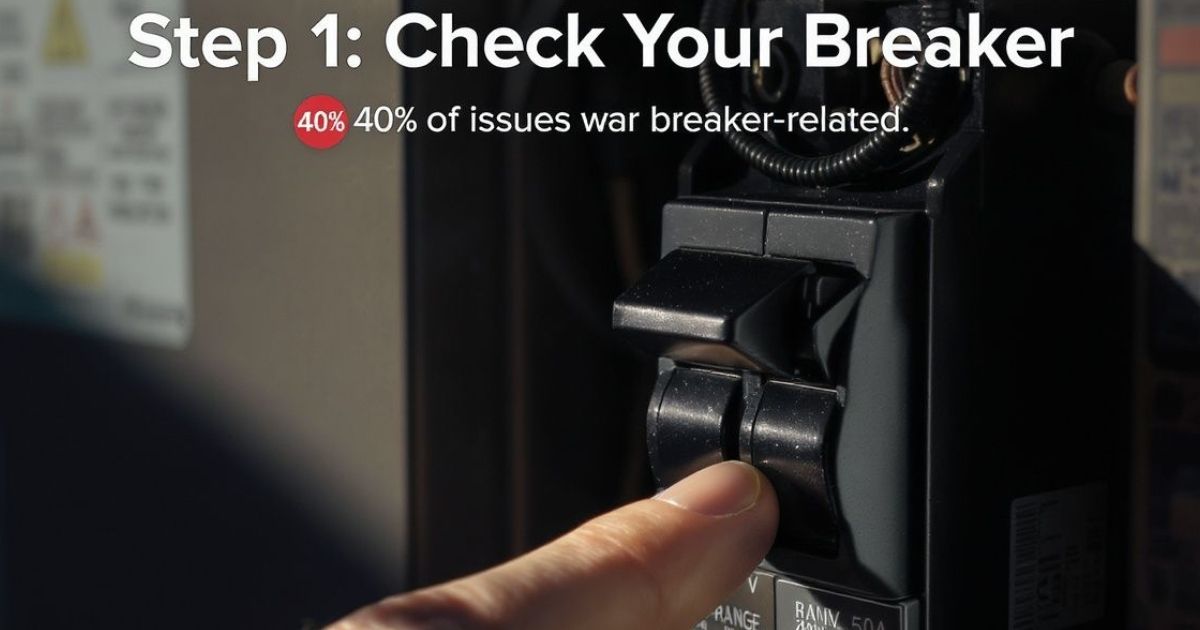
If the breaker is fine and the range still will not respond, the internal power switch or control board may have failed. This is an electrical issue. Do not try to open the unit and poke around inside on your own. A technician can test these parts safely and replace the faulty one.
When one burner on your electric range stops heating while the others work fine, the problem is usually limited to that burner and its connection. Here is how to troubleshoot it.
Most surface burner elements on electric ranges are designed to be removed and moved from one spot to another. This is the quickest way to figure out if the element itself is bad or if the socket it plugs into is the problem.
• Unplug the range or turn off the breaker.
• Pull the non-working burner element out of its socket. Most lift up and slide out.
• Place it into a different burner socket that you know works.
• Turn on the power and test. If the element now works in the new spot, the original socket is the problem. If it still does not work, the element itself needs to be replaced.
Look inside the socket where the burner plugs in. If you see any signs of burning, melting, or corrosion, the socket is damaged. A burned socket is a fire risk. Have a technician replace it before you use that burner again.
If your food is burning on one side and undercooked on the other, your range has an uneven heating problem. This is especially frustrating when you are baking. Here are the most common causes.
A burner that is slightly crooked or not sitting flat in its socket will not distribute heat properly. Remove the burner, check that the socket contacts are clean and not bent, and reseat it firmly. This is a quick fix that solves the problem more often than you might think.
Grease and food buildup around the burner area can block airflow and create hot spots. Use a damp cloth and a mild cleaner to wipe down the area around each burner. For the oven, check that the vents inside are not blocked by foil or food debris. Good airflow is important for even heating.
An element that is wearing out often shows uneven heat before it gives out completely. Watch the element while it is on. If part of it glows brightly while another section stays dim or dark, it is on its way out. Replacing it sooner rather than later will save you from a complete failure later on.
Electrical issues go beyond a simple heating element or breaker problem. If you are seeing signs like the display flickering, the clock resetting on its own, or the range acting strangely after a power outage, there may be a deeper electrical issue.
Power surges can fry the sensitive electronics inside modern electric ranges. Watch for these warning signs:
• The digital display does not light up or shows random characters.
• The clock keeps resetting, especially after a storm or outage.
• The range stopped working right after a power outage or storm.
Some electric range problems are safe to troubleshoot on your own. Others are not. Call a licensed technician if you notice any of the following:
• You smell burning or see smoke coming from inside the range.
• Any wires inside the unit look damaged, melted, or discolored.
• The circuit breaker keeps tripping every time you turn the range on.
• The control board or internal wiring needs to be checked or replaced.
• You are not sure what is wrong and do not want to risk making it worse.
Electrical work inside an appliance is not the place to learn by trial and error. A wrong move can damage the range beyond repair, void any remaining warranty, or create a safety hazard in your home.
Heating elements are a part of your electric range that actually cook your food. They are also one of the parts that wear out the fastest. Knowing how to replace them can save you time and money.
• Most stovetop elements are designed to come out and go back in without tools. Here is the basic process:
• Turn off the power to your range.
• Lift the element up slightly and slide it out of the socket.
• Take the old element to an appliance parts store or look up your range model number online to find the correct replacement.
• Slide the new element into the socket the same way the old one came out. It should click or seat firmly.
• Switch the power back on and test.
Oven elements are a bit more involved to replace than stovetop ones. Some models allow you to unscrew the element and pull it out from inside the oven. Others require you to remove a back panel. Check your range’s user manual for the right steps. If you do not have the manual, the model number on the inside of the door frame can help you find instructions online. If it feels complicated or you are unsure, a technician can quickly replace an oven element.
A little bit of regular care goes a long way toward preventing the problems we covered above. Here are some simple habits that will help your electric range last longer.
• Wipe down the stovetop after each use. Grease and food buildup cause uneven heating and can become a fire risk over time.
• Do not cover your burners with foil. It captures heat unevenly and can damage the element or the socket underneath.
• Use the right size pot or pan for each burner. A pan that is too small leaves part of the element exposed, which wears it out faster.
• Consider a whole-home surge protector if you live in an area where power surges are common. They protect your appliances' electronics from sudden voltage spikes.
• Do not ignore small problems. A burner that is slightly dim or a range that takes longer to heat up is telling you something is starting to fail. Fixing it early is always cheaper than waiting for a full breakdown.
Not sure where your problem fits? Here is a quick way to figure out what to do:
Range does not heat at all: Check the breaker, then the heating element.
Range will not turn on: Reset the breaker. If it still does not work, call a technician.
One burner not working: Swap it with another burner to find out if the element or the socket is the problem.
Uneven heating: Reseat the burner, clean the area, and check for a failing element.
Electrical or display issues: Stop troubleshooting and call a licensed technician.
Most electric range burner problems can be sorted out with a bit of patience and the right information. The key is to start simple, check the obvious things first, and know when to hand it off to someone who does this every day.
If your electric range is giving you trouble and you have already checked the basics, do not let it sit. A small issue with an electric range can turn into a bigger, more expensive problem if you wait. And when electricity is involved, it is always better to be safe than sorry.
Fixing an electric range does not have to be stressful. Most of the time, the answer is something simple a tripped breaker, a worn-out element, or a burner that just needs to be reseated. Start with the basics, work through the steps, and trust your instincts. If something feels off, if you smell burning, or if the problem goes beyond what you feel comfortable handling on your own, that is the right moment to call a professional. You now know what to look for and what to do about it, and that alone puts you ahead of the game. A little patience and the right information, and your kitchen is back to normal.
You electric range is not working. Need to fix electric range? Fair Appliance Repair Service offers same-day electric range repair in Sacramento and the surrounding areas. Licensed technicians, upfront pricing, and a 90-day labor warranty.
Don't let a small problem become a big emergency.
📞 Call now: (916) 333-8388
🌐 Book online 24/7
⚡ Same-day service available
An oven that won't heat typically has a faulty bake or broil element, broken thermostat, or bad temperature sensor. First, visually inspect the baking element at the bottom of the oven for cracks, blisters, or breaks. Turn on the oven and watch if the element glows red—if it doesn't, it needs replacement. If elements look fine but heating is inconsistent, the thermostat or temperature sensor may be malfunctioning, requiring professional diagnosis and repair.
Replace your oven heating element if you see visible damage like cracks, breaks, blisters, or burn marks. Other signs include the element not glowing red when the oven is on, heating very slowly, or only heating in certain spots. The element may also show signs of separation from its mounting brackets. Bake and broil elements typically cost $25-75 and can be replaced as a DIY project if you're comfortable with basic appliance repair.
Uneven baking happens when heating elements wear out, the temperature sensor fails, or the oven's calibration is off. A failing bake element may heat inconsistently, creating hot and cold zones. Blocked vent openings or a worn door gasket can also affect temperature distribution. Test your oven's accuracy with an oven thermometer—if it's off by more than 25°F, recalibrate it or call a technician to replace the temperature sensor.
Simple fixes like replacing visible heating elements, cleaning oven components, or replacing a worn door gasket are safe DIY tasks. However, call a professional for issues involving the control board, electronic controls, temperature sensor replacement, thermal fuse problems, or internal wiring. Also seek expert help immediately if you smell gas (if it's a dual-fuel unit), see sparks, or if the oven trips your circuit breaker—these indicate serious safety hazards.
An oven that trips breakers usually has a short circuit in the bake or broil element, damaged internal wiring, or a grounded heating element touching the oven chassis. Moisture from spills or cleaning can cause shorts if it reaches electrical components. First, turn off power at the breaker and visually inspect elements for damage or areas touching metal. If elements appear intact, internal wiring or the terminal block may be faulty—both require immediate professional repair to prevent electrical fires.


