
Our Articles


Blog

Published on May 11, 2026
If your refrigerator is not cooling, leaking water, making noise, or leaving food warm, the problem can become urgent fast. For Rancho Cordova homes, one cooling issue can mean spoiled groceries, soft freezer items, and a stopped ice maker.
A fridge not cooling does not always mean the compressor failed. The cause may be dirty condenser coils, blocked air vents, a weak door gasket, bad evaporator fan, clogged drain line, or water filter problem.
This guide explains refrigerator repair tips Rancho Cordova homeowners can use and when refrigerator repair in Rancho Cordova CA is safer.
• A refrigerator not cooling can come from airflow problems, dirty coils, weak seals, fan failure, sensors, or compressor parts.
• Freezer cold but refrigerator warm usually means cold air is not reaching the fresh food compartment.
• Ice maker not working, refrigerator leaking water, and freezer frost buildup often need separate checks.
• Rancho Cordova heat can make older refrigerators run longer and reveal weak parts.
• Compressor, control board, refrigerant leak, and sealed system issues need professional diagnosis.
• Fridge Not Cooling in Rancho Cordova?
• Freezer Cold but Refrigerator Warm?
• Ice Maker, Water Leak, and Frost Problems
• Rancho Cordova Heat and Refrigerator Cooling
• Refrigerator Noise Problems
• When to Call a Technician
• Repair or Replace Your Refrigerator?
Most refrigerators should stay near 37 degrees Fahrenheit, and most freezers should stay near 0 degrees Fahrenheit. If the setting changed by mistake, the refrigerator warm inside problem may be easy to correct. If the setting is right but food still feels warm, check airflow, coils, and seals.
Cold air needs room to move between the freezer compartment and fresh food compartment. If containers block the air vents, the fridge may stay warm even when the freezer feels cold. This is a common reason people search for fridge not cold but freezer works or refrigerator running but not cooling.
Condenser coils help release heat from the refrigerator. When they collect dust, pet hair, or grease, the fridge works harder. Dirty condenser coils can cause long run times, weak cooling, higher energy use, and extra compressor strain during Sacramento Valley heat.
A weak door gasket lets warm air enter the refrigerator. That warm air can cause condensation, freezer frost buildup, food spoilage, and longer run times. If the door seal is cracked, loose, dirty, or not closing tightly, the refrigerator may struggle to hold a safe temperature.
When the freezer is cold but refrigerator warm, the freezer may still be making cold air, but that air is not reaching the fridge section. Common causes include blocked vents, frost buildup, a stuck air damper, a bad evaporator fan, or a defrost system problem.
Heavy frost on the freezer wall can block airflow into the fresh food section. If frost returns after you remove it, the defrost heater, defrost thermostat, thermistor, or control board may need testing. Do not chip ice with sharp tools because you can damage the liner or refrigerant line.
The evaporator fan moves cold air through the refrigerator and freezer. If the fan is not running, the freezer may stay cold while the fridge gets warm. A refrigerator fan not working can also cause uneven cooling, rattling sounds, or warm shelves near the top.
Ice maker not working, refrigerator leaking water, and freezer frost buildup are different problems. This table shows what each symptom may mean.
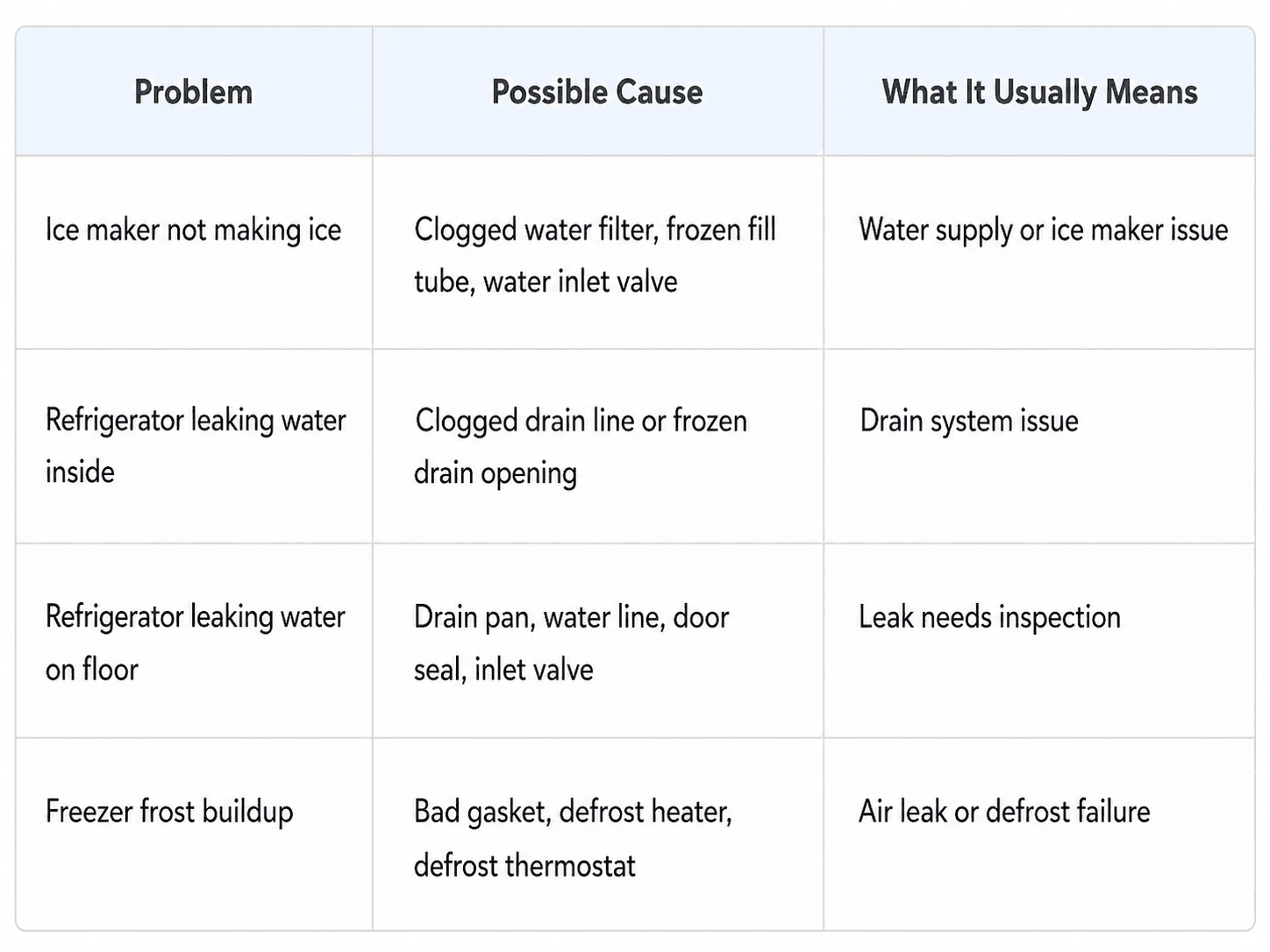
An ice maker not working can come from a clogged water filter, frozen fill tube, low water pressure, bad water inlet valve, freezer temperature issue, or ice maker assembly failure. If the ice maker not working but water dispenser works, the ice maker, fill tube, or freezer temperature should be checked.
A refrigerator leaking water inside may have a clogged drain line or frozen drain opening. A refrigerator leaking water on floor may involve a cracked drain pan, loose water line, damaged door seal, bad water inlet valve, or filter housing issue. If the leak returns, the root cause is still present.
Rancho Cordova homes deal with hot Sacramento Valley summers. During heat waves, refrigerators run longer to remove heat and keep food cold. Older units may show refrigerator temperature keeps changing, soft freezer items, warm drinks, or refrigerator food spoiling fast.
Garage refrigerators can struggle because garage temperatures often rise far above indoor temperatures. A unit in a hot garage may click, buzz, run constantly, or fail to keep food cold. This is common in Sacramento County refrigerator repair and refrigerator repair near Sacramento calls.
Dirty coils, weak seals, blocked vents, and aging fan motors become more noticeable in summer. A small issue that seemed minor in spring can become a cooling failure in July. This is why Rancho Cordova refrigerator repair often starts with airflow, coils, door seals, and fan operation.
A refrigerator clicking noise may come from the start relay or compressor trying to start. If the clicking repeats and the refrigerator is not cooling, the start relay, compressor, or control board may need testing. This can be related to refrigerator compressor repair Rancho Cordova service.
A refrigerator buzzing noise can come from the compressor, condenser fan, evaporator fan, or water inlet valve. Light humming can be normal, but loud buzzing with weak cooling should not be ignored. Buzzing near the back of the fridge can point to a fan or compressor area problem.
Rattling may come from a loose panel, vibration, or fan blade touching ice or debris. Grinding can point to a fan motor problem. If the sound changes when the door opens or closes, the evaporator fan may be involved.
Cooling problems may involve condenser coils, evaporator fan, condenser fan, air vents, air damper, compressor, or start relay. Temperature and frost problems may involve the thermistor, temperature control thermostat, defrost heater, defrost thermostat, or control board. Water and ice problems often involve the water inlet valve, water filter, drain line, drain pan, ice maker, or water dispenser.
A refrigerant leak or sealed system issue is not a DIY repair. If the refrigerator is warm in both sections, runs constantly, and basic airflow checks do not help, a trained technician should inspect it.
Call a refrigerator technician Rancho Cordova homeowners can trust if the refrigerator stays warm after checking temperature settings, vents, coils, and door seals. A technician can test fans, sensors, wiring, control board, and compressor circuit safely.
A refrigerator compressor not starting can be caused by a bad start relay, compressor failure, power problem, or control board issue. The symptoms can look similar, so testing matters before deciding whether repair or replacement makes sense.
Call for refrigerator repair in Rancho Cordova CA if water leaks return, frost keeps building up, food keeps spoiling, or the breaker trips. Repeated problems often mean the root cause was not fixed.
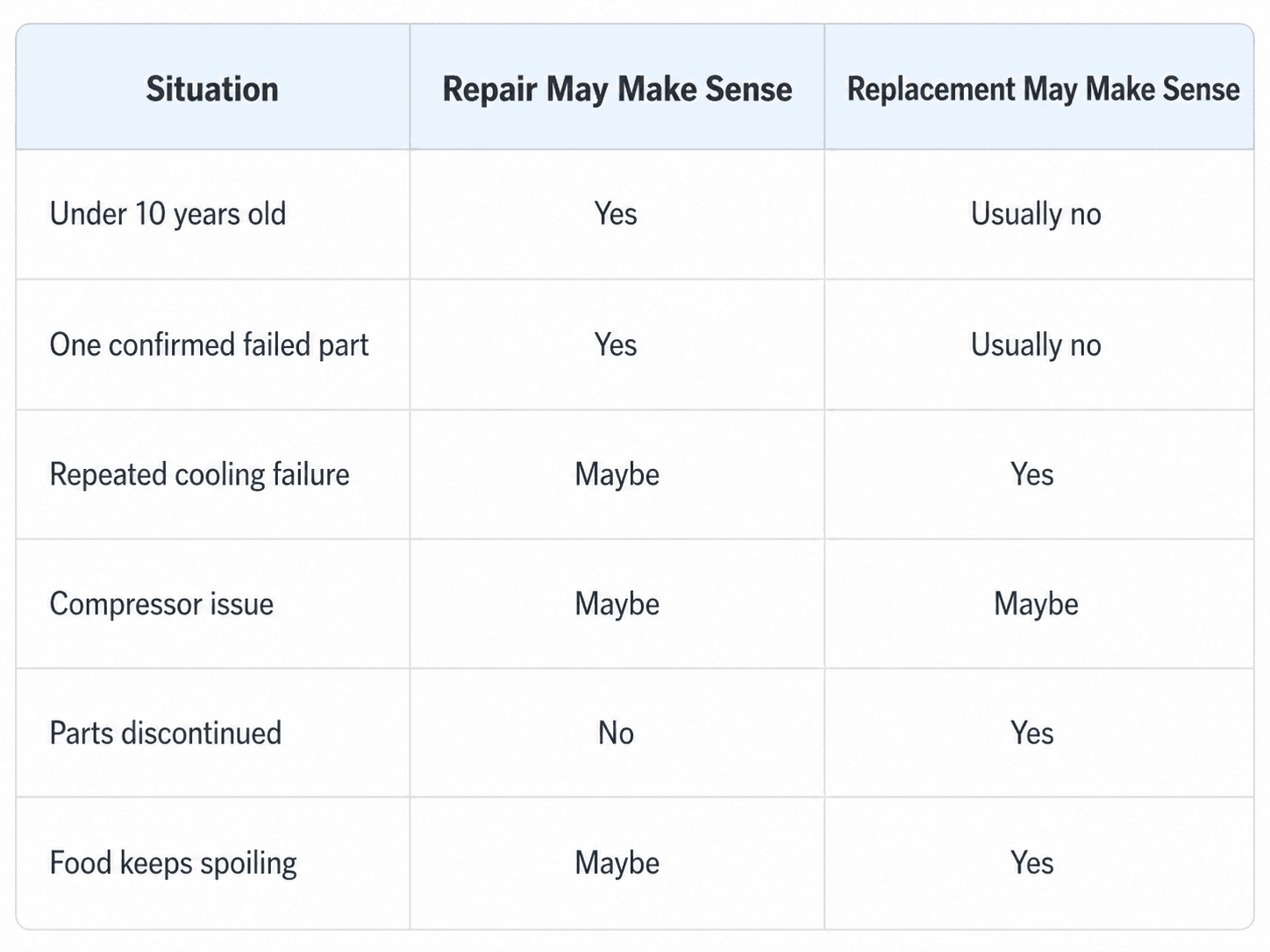
A repair may be worth it when the refrigerator is newer and one confirmed part has failed. Replacement may be better when the unit is older, parts are discontinued, or cooling problems keep returning.
Many local homes use Whirlpool, GE, Samsung, LG, KitchenAid, Frigidaire, Maytag, Kenmore, Bosch, Electrolux, JennAir, Sub-Zero, and Thermador refrigerators. Brand-specific diagnosis matters because each model can use different parts, layouts, and control systems.
Fair Appliance Repair Service helps Rancho Cordova and nearby Sacramento-area homeowners when refrigerator problems continue after basic checks. If your fridge is still not cooling, leaking water, making clicking or buzzing sounds, or causing food to spoil, the issue may need professional diagnosis.
Our certified, licensed, and insured technicians service major refrigerator brands and provide clear, upfront pricing before repair work begins. Fair Appliance Repair Service is BBB and Google Guaranteed, and same-day or next-day appointments may be available when scheduling allows.
Company Name: Fair Appliance Repair Service
Address: Sacramento, USA
Phone Number: (191) 633-38388
Visit Google Business Profile
A refrigerator can take 4 to 24 hours to cool fully after being unplugged, reset, moved, or repaired. The time depends on the room temperature, food load, door openings, and refrigerator condition. If it stays warm after 24 hours, the cooling system may need diagnosis.
Food may not be safe if the refrigerator stays above 40 degrees Fahrenheit for more than 2 hours. Meat, dairy, seafood, cooked food, and leftovers can spoil quickly. When in doubt, throw it out to avoid foodborne illness.
Food may freeze in the refrigerator section because the temperature is set too low, air vents are blocked, the damper is stuck open, the thermistor is faulty, or the control board is sending the wrong signal. Start by checking the temperature setting and food placement.
Condensation inside a refrigerator often comes from warm air entering the fridge. Common causes include a weak door gasket, frequent door opening, hot food placed inside, blocked vents, or high indoor humidity. If moisture keeps returning, the seal and airflow should be checked.
Most refrigerator water filters should be replaced every 6 months, but the timing can vary by brand, water quality, and usage. A clogged filter can reduce water flow, affect the ice maker, and make the water dispenser slow.
Yes, a power outage or surge can sometimes affect the refrigerator control board, start relay, compressor, or electronic display. If the refrigerator will not cool, clicks repeatedly, shows an error code, or will not restart after power returns, it may need inspection.


