
Our Articles


Blog

Published on May 10, 2025
You open the fridge, press the dispenser, and the water trickles out at half the speed it used to. Or you hand your kid a glass and they make a face because it tastes off. Or that red filter light has been staring at you for a month and every time you walk past it, you think, I will deal with that this weekend.
This is the refrigerator water filter replacement guide that actually gets you through it, start to finish, no tools required. Whether you have a Whirlpool, Samsung, Kenmore, GE, Maytag, Frigidaire, Bosch, or any other brand, this guide walks you through everything. How to find the right filter for your exact model, how to replace it step by step, what to do when something goes wrong, and how to know when the problem is bigger than just the filter.
• Strange taste after a new filter. Here is the fix.
• Filter stuck and will not budge. One method works every time.
• New filter leaking. Almost always a one-minute fix.
• Not sure which filter fits. Find the right one without guessing.
• Red light still on after replacement. Why it never resets and how to fix it by brand.
• Slow water flow after replacement. Here is what is actually causing it.
• Replaced it twice and nothing changed. The problem is not the filter.
Most manufacturers recommend every six months or every 200 to 300 gallons, whichever comes first. But that is just the baseline.
A household of five people using the dispenser constantly will wear through a filter faster than a couple who barely touches it. Homes with higher sediment or chlorine levels in the tap water will see filters degrade even quicker. And if your water is already tasting off or flowing slowly, do not wait for the six-month mark. The filter is already past its prime.
• Water flow from the dispenser has noticeably slowed and feels weaker than it used to.
• Your water or ice has a stale, earthy, or chlorine-like taste that was not there before.
• The water looks slightly cloudy or has a faint gray tint when you dispense it.
• Ice cubes smell or taste strange even though the freezer itself seems fine.
• White chalky residue is building up around the dispenser nozzle.
•The filter indicator light has turned yellow, orange, or red.
• It has been more than six months since your last replacement, even if everything still seems okay.
• If two or more of those apply to you right now, change the filter today. Do not wait.
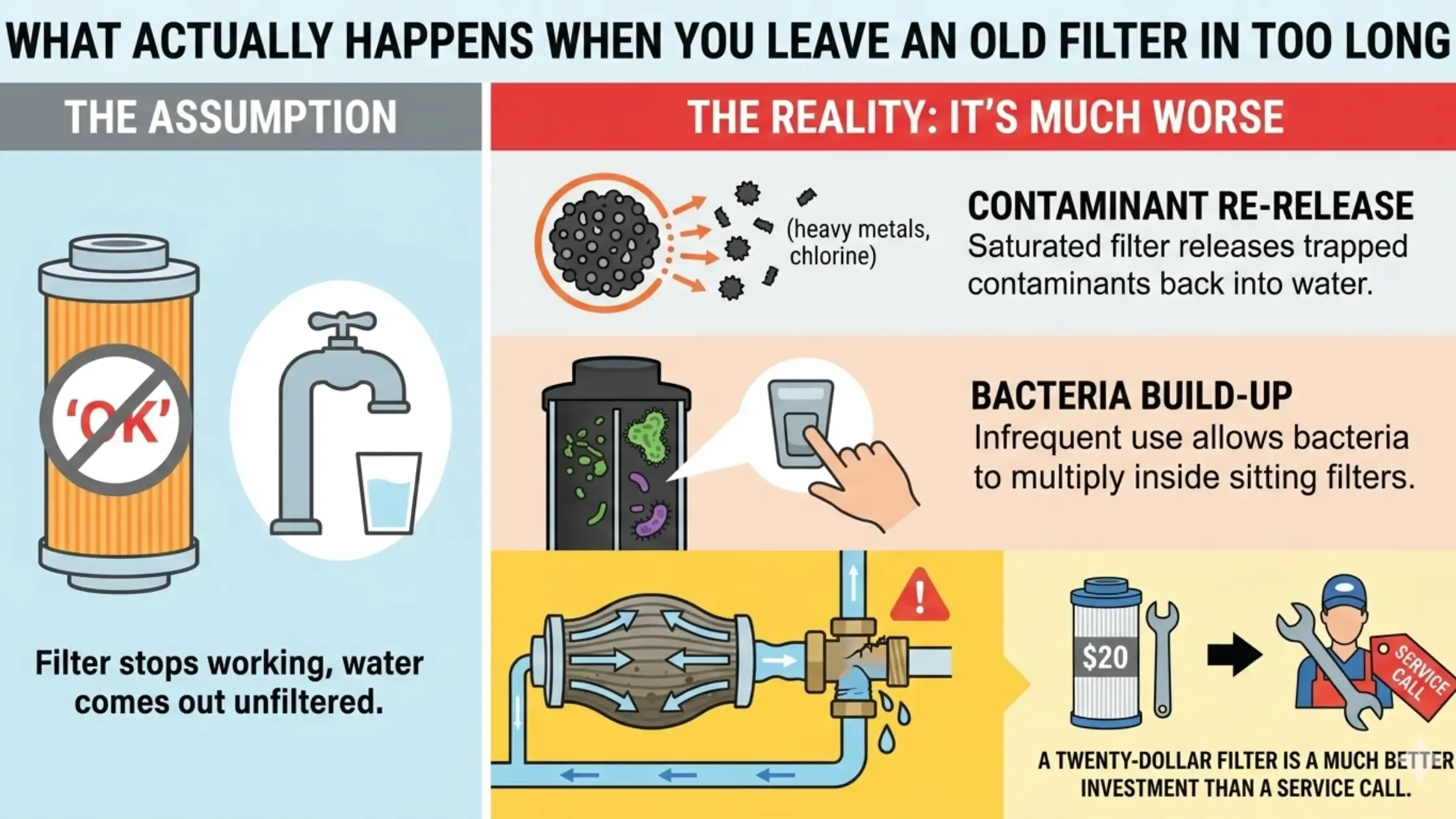
A lot of people assume an expired filter just stops working and the water comes out unfiltered. The reality is worse than that. The activated carbon inside a saturated filter can start releasing contaminants back into your water rather than capturing them. In homes where the dispenser is used infrequently, bacteria can build up inside a filter that has been sitting too long.
On the appliance side, a severely clogged filter puts constant extra pressure on your refrigerator's water inlet valve. That valve is not cheap to replace. A twenty-dollar filter is a much better investment than a service call.
This is the step most people rush past, and it is the reason so many filter replacements end up with leaks, poor fit, or water that tastes no different after the swap.
• Find your refrigerator's model number. It is almost always on a sticker inside the refrigerator door, on the interior side wall, or on the back of the unit.
• Once you have that number, go to the manufacturer's website or a major retailer and search for compatible filters. Do not guess. Do not assume the filter that worked in your last refrigerator will work in this one.
• Every brand has its own naming system. Whirlpool and Maytag use EveryDrop filters numbered one through five. Samsung uses HAF-series filters like the DA29-00020B. LG uses the LT700P or LT1000P. GE has the RPWFE, XWFE, and MSWF. Frigidaire uses PureSource filters. Kenmore varies depending on the manufacturer behind the model, which is explained in the brand section below.
• Five minutes of checking now saves a lot of frustration later.
The filter design varies by brand but the core process is nearly identical across every refrigerator made in the past 20 years. Follow these steps and you will be done in under 15 minutes.
Fridge water filters live in one of two places. Either in the upper-right corner inside the refrigerator compartment inside a cylindrical housing, or in the base grille at the very bottom front of the unit. If you are not sure which one your model has, a quick search of your model number will tell you immediately.
First Almost every guide skips this step. Before you remove the filter, turn off your ice maker. If the ice maker tries to cycle while the filter housing is open, it pulls air into the water line. That air creates extra flushing work later and can cause the ice maker to behave strangely for a day or two after the job is done. Thirty seconds now saves a real headache later.
For twist-style filters, grip firmly and rotate a quarter turn counterclockwise until it releases. For push-button filters, press the release button and it pops right out. Keep a small towel nearby because a few drops of water is completely normal.
Note: If the filter is stuck- This happens more than you think, especially in homes with hard water. Do not force it. Pull on a rubber glove for better grip and apply slow steady counterclockwise pressure. Still not moving? Wrap a cloth around a pair of pliers and use gentle turning force. Take your time. Forcing it can crack the housing, which is a much bigger problem than a stuck filter.
Some refrigerators, particularly older KitchenAid and certain Whirlpool models, use a separate cap that needs to transfer from the old filter to the new one. If you throw that cap away with the old filter, your new filter will not seat correctly. Check the end of your old filter before you toss it. If there is a cap attached, remove it carefully and press it onto the same end of your new filter.
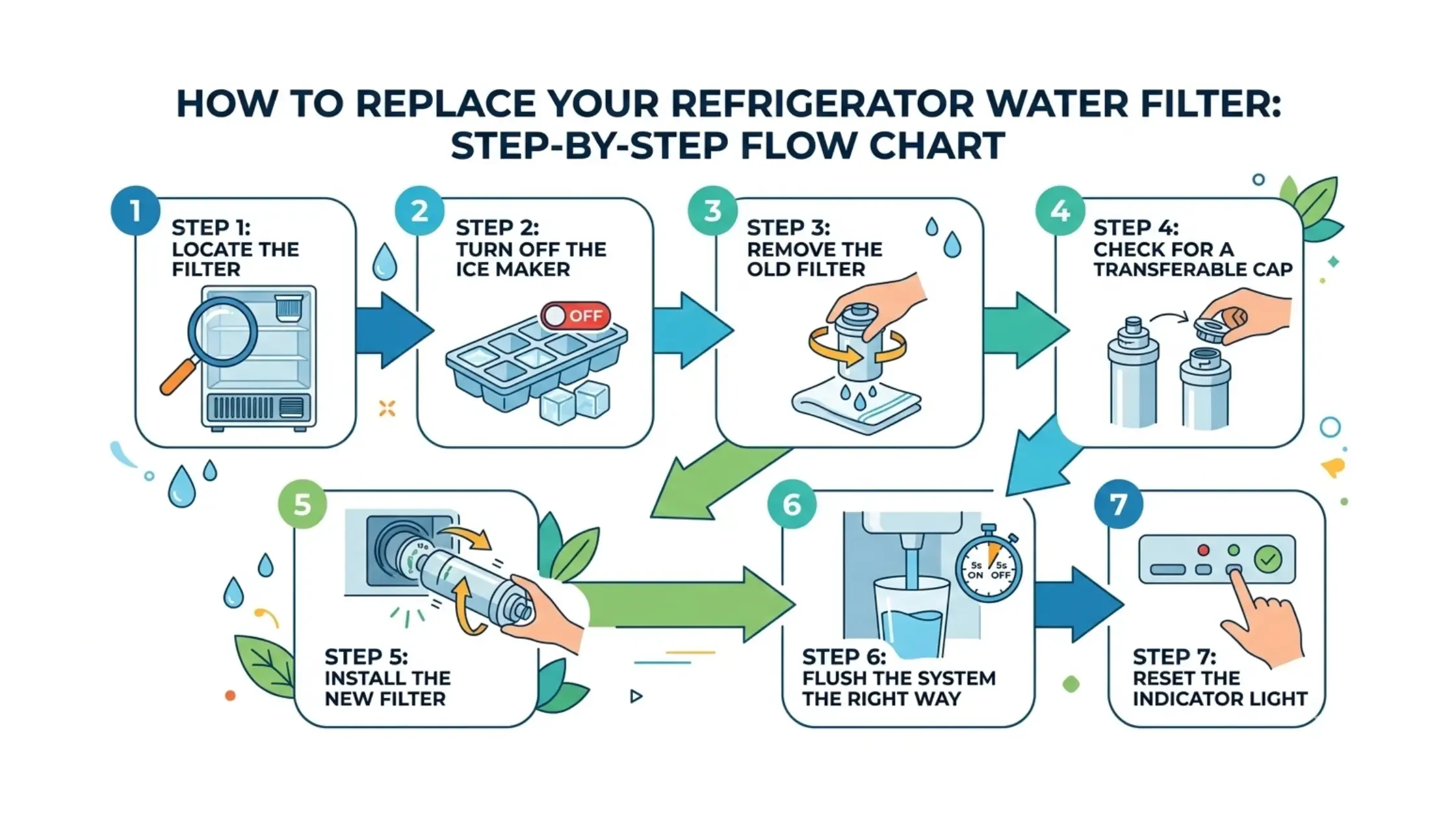
Remove any protective covers from the new filter. Look at the O-rings, the small rubber rings near the end of the filter, and confirm they are smooth and properly seated. A twisted or pinched O-ring is the single most common cause of leaking after a new filter install. It takes five seconds to check and saves a soggy floor.
Most filters have a small arrow or alignment marking on them. Make sure that arrow is pointing upward when you insert the filter. Push in and rotate clockwise until you feel resistance and hear a click. That click means it is fully locked. If it is not going in smoothly, stop and recheck the alignment. Do not force it.
Do not skip this and do not do it wrong. Dispensing water continuously after a new filter install does not clear air pockets effectively. Instead, dispense in intervals of five seconds on, five seconds off. The stop-start method pushes trapped air out of the lines in a way that a continuous stream cannot.
Keep going until you have run about four gallons through. This takes roughly five minutes. Your water will probably look gray or even slightly black at first. That is carbon fines from the new filter and it is completely harmless.
Keep flushing and it clears up on its own. After flushing, give the refrigerator about 24 hours before you judge the taste. The filter needs a full cycle to settle in properly.
Your refrigerator has no way of detecting that you installed a new filter. The light is on a timer, not a sensor, so it has to be manually reset every single time.
On most models you press and hold a designated button on the control panel for three to five seconds until the light changes. The exact button varies by brand and is covered in the sections below.
If you skip this, the light stays on and you lose all track of when your next replacement is actually due.
Most Whirlpool models use EveryDrop filters numbered one through five. The number matters. Do not assume any EveryDrop filter fits your unit.
Confirm the exact number using your model before buying. Older models use twist-style filters in the upper-right interior. Newer models often use a push-button release design.
Reset: Hold the Filter or Water Filter button for three seconds until the light changes to green or turns off. Most Common Problem: The light refuses to reset no matter how long you hold the button. Unplug the refrigerator for 60 seconds, plug it back in, let it fully restart, and try the reset again.
Here is the detail that trips up almost every Kenmore owner. Kenmore refrigerators are built by different manufacturers depending on the model. If your model number starts with 106, it is Whirlpool-based and uses EveryDrop filters. If it starts with 795, it is LG-based and uses LT-series filters like the LT700P.
Order the wrong one and it will not fit.
Kenmore Elite: Elite models often have top-mount interior filters. Common compatible filters include the 46-9690 and 46-9999 depending on the series. Some Elite models require holding Light and Lock simultaneously. Check your manual if neither works.
Most Common Problem: Older Kenmore units are notorious for filters that are nearly impossible to remove due to years of mineral buildup. Use the stuck filter method from Step 3, go slow, and do not force it.
Reset: Hold the Filter Reset button for three seconds.
Most standard Frigidaire models have a push-in PureSource filter in the upper-right interior of the compartment. Frigidaire Gallery: Gallery models are different.
The filter is typically in the base grille, not inside the refrigerator. A lot of Gallery owners spend ten minutes searching the interior before realizing this. Open the grille cover at the bottom, turn the filter counterclockwise to release, swap it out, rotate the new one clockwise to lock, and close the grille.
Reset: Hold Filter Reset for three seconds. On Gallery models the reset option may appear in the control panel display menu. Most Common Problem: The push-in filter does not fully click into place, causing a slow drip after installation. Push straight in with firm even pressure before attempting to rotate and lock.
Samsung uses HAF-series filters and the location depends on the model type, which causes a lot of confusion. French Door models have the filter in the upper-right interior of the compartment. Side-by-Side models may have it in the base grille or the interior depending on the specific unit. If you are not sure which applies to yours, check the user manual before you start looking.
Reset: Hold Ice Type and Child Lock simultaneously for three seconds. Some models use an Alarm button or a dedicated Filter Reset button instead. Most Common Problem: The indicator light resets but comes back on within a day or two. Hold the reset combination for a full five seconds rather than three. A quicker press often does not fully register.
GE uses a twist-and-lock design. The most common filters are the RPWFE, XWFE, and MSWF. One thing GE owners consistently get wrong: GE Profile models often require different filters than standard GE units. The RPWFE and XWFE look nearly identical but are not interchangeable. Always verify with your specific model number.
Reset: Hold the Reset Filter button for three seconds. Some models use the Ice and Water button instead.
Maytag runs on the Whirlpool platform and uses EveryDrop filters. The installation process is nearly identical to Whirlpool. Confirm your specific EveryDrop number using your Maytag model number rather than assuming it matches a Whirlpool you may have had before.
Reset: Hold Filter Reset for three seconds until the light changes.
Bosch uses the BORPLFTR filter series. The most important thing to know about Bosch filters is this: push the filter fully into the housing before you try to turn and lock it. Most Bosch installation problems happen because owners try to rotate the filter before it is fully seated. Push first, then turn.
Most Common Problem: Leaking right after installation, almost always from the filter not being pushed all the way in or from an O-ring that shifted during install. Remove it, check the O-rings, and reinstall carefully.
Reset: Hold the Filter button for five seconds. Some models require a specific button combination listed in the owner's manual.
Jenn-Air, Thermador, and Hisense Jenn-Air is built on the Whirlpool and Maytag platform. Thermador is built on the Bosch platform. Both follow the same steps as their respective parent brands. Hisense typically uses twist-in interior filters following the universal steps. For all three, confirm the exact filter model number for your specific unit before ordering.
Before you panic or call anyone, know that a leak right after installation is the most common thing we hear about, and in the overwhelming majority of cases it is a one-minute fix, not a service call.
Remove the filter completely. Check the O-rings and make sure they are smooth, properly seated, and not twisted or pinched. Reinstall with attention to full seating before you attempt to lock. If it still leaks after a careful reinstall, confirm you have the correct filter model for your refrigerator.
A wrong-model filter that almost fits is the other most common cause. If the leak continues after a careful reinstall, it may be an internal water line issue something our refrigerator repair Sacramento service technicians see and fix regularly.
This one scares a lot of people but it is actually the least worrying thing on this list. What you are seeing is carbon fines, tiny particles from the activated carbon inside the new filter. It is completely harmless and it always clears up.
Keep flushing using the five-seconds-on, five-seconds-off method. Most filters clear within four gallons. If your water is still showing color after six gallons, the filter itself may be defective. Contact the manufacturer or retailer for a replacement.
This is frustrating, especially when you just went through the whole replacement process. But in almost every case, strange taste after a new filter comes down to one of two things and neither of them means something is seriously wrong. Most likely it is not enough flushing. Run another two gallons and then give it a full 24 hours.
The filter needs time to settle in and the taste genuinely improves after a day. If the taste issue is still there the next morning, run your tap water directly and compare. If the tap has the same off taste, the problem is your home's water supply, not the filter.
This is one of the most common calls we get and it almost always has a simple fix. Filters that have been sitting for a long time, especially in areas with hard water, can seize in the housing from mineral buildup. It feels impossible but it is not. Use a rubber glove for grip and apply slow steady counterclockwise pressure.
Do not jerk it. For filters that are genuinely stuck, wrap a cloth around the end of a pair of pliers and apply gentle turning force. For base grille filters, confirm the grille panel is fully open before you try to turn. Take your time. A cracked filter housing from forcing it is a much bigger problem than a stuck filter.
This confuses almost everyone the first time because it feels like the refrigerator should just know you put a new filter in. It does not. The light is on a timer, not a sensor, so it has to be manually reset every single time. Hold the reset button for a full five seconds rather than three.
A quick press often does not fully register. If it still does not respond, unplug the fridge for 60 seconds, let it fully restart, and try again. If the light resets but comes back on within a day or two, the control board may not be registering the reset correctly, which is a separate issue worth having looked at.
Slow flow after a new filter is almost always air trapped in the water lines, which means the fix is usually just more flushing. Keep going past the standard four gallons. In some cases, especially when a refrigerator has been moved recently or the water was shut off for a while, it can take six or more gallons to fully clear.
If flow is still noticeably weak after six or more gallons, check two things. First, confirm the water supply valve behind the refrigerator is fully open. Second, check the supply line for any kinks. Either of those can restrict flow in a way that has nothing to do with the filter.
OEM filters from the manufacturer are guaranteed to fit and are tested specifically for your model. They cost more, usually between thirty and sixty dollars, but carry zero compatibility risk.
Generic filters are often significantly cheaper and many of them perform just as well. The key is certification. Look for NSF/ANSI Standard 42, which covers chlorine reduction and taste improvement, and NSF/ANSI Standard 53, which covers health-related contaminant reduction including lead.
A filter with both certifications has been independently tested and meets the same safety standards as the original NSF/ANSI Standard 42 and 53. If you see NSF/ANSI Standard 401 as well, that covers emerging contaminants like certain pharmaceuticals and is worth having if water quality is a priority.
Avoid cheap unbranded filters with no certifications listed anywhere on the packaging. The few dollars saved are not worth the risk of poor filtration or a bad fit that causes leaks.
Most refrigerator water filters cannot go into standard curbside recycling. Some brands participate in recycling programs through TerraCycle. Check the manufacturer's website to see if a program exists for your filter. If not, it can go in regular household trash.
You replaced the filter. You flushed four gallons. You reset the light. And something is still wrong. At that point, stop buying filters. The problem is somewhere else.
These are the signs that no filter replacement is going to fix your problem. Water flow is still weak after full flushing and the supply valve is confirmed open.
Water tastes bad even with a brand new certified filter after thorough flushing. Water is pooling under the refrigerator or inside the unit near the water lines. The filter housing itself looks cracked or damaged. The ice maker stopped working around the same time the water issues started.
These point to a failing water inlet valve, a damaged supply line, a cracked filter housing, or an internal water system issue.
We have seen homeowners go through four or five filters trying to fix a problem that turned out to be a faulty inlet valve the whole time. It is an easy mistake to make and an expensive one.
If your water system is still not right after a proper refrigerator water filter replacement, it is time to stop guessing and get a real answer.
Fair Appliance Repair Service has completed over 4,000 appliance repairs across the Sacramento area since 2015. We carry a BBB A+ rating and more than 700 five-star reviews from real local customers. We offer same-day diagnostics, upfront pricing, and a 90 to 365-day warranty on every repair. No surprises, no pressure.
Call us at 916-333-8388 or book your appointment online today for refrigerator filter replacement.
Every six months or every 200 to 300 gallons. Heavy users may need to replace closer to every four months.
Carbon fines from the new filter. Completely harmless. Flush four gallons using the five-seconds-on, five-seconds-off method and it will clear up.
Usually means the filter was not flushed enough. Run a few more gallons and give it 24 hours. If it persists after that, the filter may be defective and worth exchanging.
Use a rubber glove for grip and apply slow steady counterclockwise pressure. For stubborn filters, use a cloth-wrapped pair of pliers with gentle turning force. Never force it suddenly.
It does not reset itself. Hold the reset button for three to five seconds. If it does not respond, unplug the refrigerator for 60 seconds, restart it, and try again.
Most modern refrigerators have an automatic shutoff in the filter housing. If you have an older unit or are unsure, turn off the supply valve behind the refrigerator before you start.
Yes, using a bypass plug. Without one, some models will not dispense water at all. Without filtration, contaminants from your tap water pass directly into your drinking water and ice.


