
Our Articles


Blog

Published on January 20, 2026
You open the lid, expecting fresh, clean laundry. Instead, you find your clothes floating in a pool of gray, soapy water. It is a nightmare scenario, but before you start bailing water with a cup, stop and unplug the machine.
Safety is critical when dealing with standing water and electricity. Once the power is cut, listen closely. Did you hear a humming noise before it stopped? That usually means the pump is trying to work but is jammed. If it was silent, the issue might be electrical.
At Fair Appliance Repair Service, we see this issue daily in Sacramento. Whether it is a sock stuck in a front-loader pump or a lid switch failure on a top-loader, the cause is usually a blockage or a failed signal. This guide will help you find the clog and get the water moving again.
A washing machine usually stops draining because the drain path is blocked or the pump has failed. The most common culprit is the "Coin Trap" filter being clogged with small items like coins or socks. Other frequent causes include a kinked drain hose, a broken lid switch (which disables the drain cycle), or a burned-out drain pump motor.
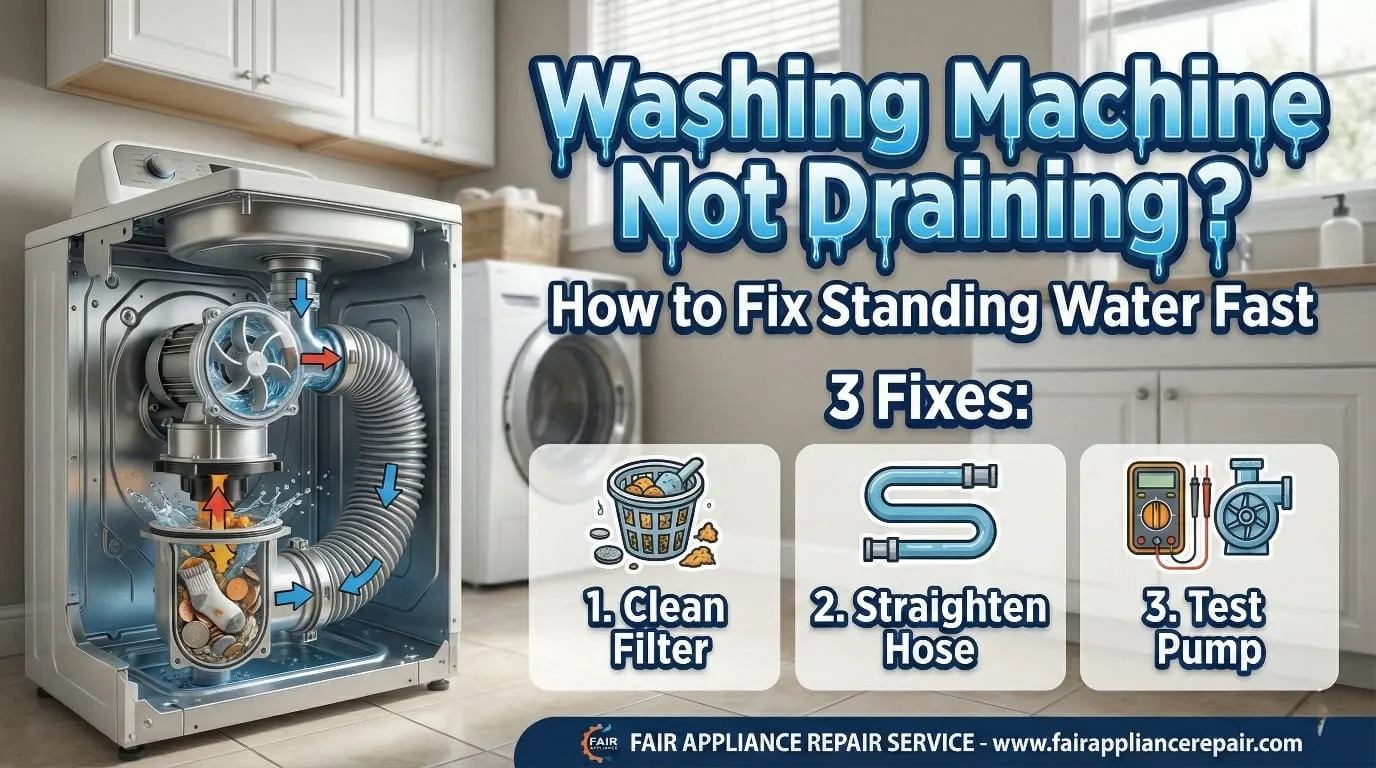
If your washing machine will not drain, 80% of the time, the problem is the filter.
Modern washers (especially front loaders) have a "Coin Trap" designed to catch debris before it hits the delicate impeller blades of the pump. If this trap gets full of lint, coins, or hair, the water cannot pass.
● Front Loaders: Look for a small access door at the bottom front of the machine. Open it, place a shallow baking dish underneath to catch the water, and unscrew the filter counter-clockwise.
● Top Loaders: These are trickier. The filter is often located inside the drain pump housing, which usually requires removing the front panel or tilting the machine back to access the pump underneath.
● The Fix: Pull out the debris. You might be surprised to find a missing sock or $1.50 in change. Spin the impeller (the little fan inside) with your finger to make sure it moves freely.
Sometimes the machine is fine, but the exit is blocked. If you are searching for water not draining from washer, check the hose behind the unit.
● The Kink Check: Did the washer walk or shake during the spin cycle? It might have pushed itself back against the wall, crushing the drain hose. Straighten it out.
● The Height Requirement: Drain hoses must follow gravity rules. If the hose is pushed too far down into the standpipe (the wall pipe), it can create a vacuum seal or siphon water back in. Ensure there is an air gap.
● The U-Bend Clog: Disconnect the drain hose from the wall and blow through it (or run water through it outside). Grease and lint love to build up in the "U" shape bend.
Is your washer not draining or spinning? If both functions are dead, look at the safety features.
●F As a safety precaution, washing machines will not drain or spin if they think the lid is open. On older top-loaders, a small plastic tab on the lid pushes a switch. If that tab snaps off, the machine sits full of water, waiting for the lid to "close."
● The Diagnostic: With a top loader, use a screwdriver to gently press the switch mechanism. If the drain cycle starts, your switch is broken or misaligned.
If the filter is clean, the hose is straight, and the lid switch clicks, your drain pump motor might be dead.
● The Symptom: You hear silence during the drain cycle, or a faint "buzzing" that doesn't sound like a spinning motor.
● The Test: This requires a multimeter. Unplug the machine, access the pump, and remove the wire harness. Test the motor terminals for continuity (resistance).
● The Result: If your meter reads "OL" (Open Line) or infinity, the internal windings have burned out. No amount of cleaning will fix this; you need a replacement pump.
● Safety Note: This test involves working near water lines and electrical components. If you aren't comfortable with this level of diagnosis, this is the point where calling Fair Appliance Repair Service is safer than guessing.
Different brands speak different languages. If you have a digital display, look for these codes:
Samsung Washer: Look for "5E", "SE", or "nd" (Not Draining). This is almost always a debris filter clog.
● LG Washer: The "OE" code stands for "Output Error" (cannot get water out). Check the drain hose for kinks.
● Whirlpool / Maytag: Codes like "F9 E1" indicate long drain times.
● GE Washer: Look for "H2O" or specific drain timeout alerts.
Is it worth fixing? Here is the realistic pricing for the Sacramento area this year.
DIY Part Costs:
● Drain Pump: $40 – $120 (Depending on brand).
● Lid Switch: $20 – $50.
● Drain Hose: $15 – $30.
Professional Repair Costs (Typical in the Sacramento Area):
● Service Call + Diagnosis: $75 – $120.
● Pump Replacement (Parts & Labor): $180 – $280.
● Lid Switch Assembly: $140 – $200.
● Clog Removal (Deep System Clean): $120 – $160.
You Can Usually DIY When:
● The filter was obviously clogged with coins or socks.
● The drain hose was kinked behind the machine.
● A simple reset cleared the error code.
You Should Call a Pro When:
● The pump is silent or makes a grinding noise (impeller failure).
● You suspect a bad lid switch or control board.
● There is water leaking onto the floor while trying to drain.
If you’re in Sacramento, Citrus Heights, Rocklin, Elk Grove, Fair Oaks, Antelope, Rio Linda, Roseville, Davis, Carmichael, Elverta, West Sacramento, Woodland, Granite Bay, North Highlands, Orangevale, Rancho Cordova, or McClellan Park, Professional Washing Machine Repair service same‑day option for dishwasher not filling with water problems.
● Phone: +1 916‑333‑8388
● Service: Licensed, insured, same‑day appointments when available
● Warranty: 12‑month warranty on most parts we install
Unplug the machine. If you have a front loader, use the small drain tube next to the filter (bottom front). If you don't have one, or have a top loader, lower the main drain hose into a large bucket on the floor. Gravity will do the rest.
Vinegar helps dissolve soap scum and hard water calcium (common in Sacramento), but it won't dissolve a sock or a coin. Vinegar is good for maintenance, not for fixing a "not draining" emergency.
A grinding or rattling noise during the drain cycle usually means a hard object (like a coin, button, or bra wire) is bouncing around inside the pump impeller. Stop the machine immediately to prevent the object from shattering the plastic impeller blades.
Listen to the machine. If it is completely silent when it should be draining, it is likely the lid switch (the computer hasn't sent the signal). If it hums, buzzes, or tries to start but fails, it is likely the drain pump.


