
Our Articles


Blog

Published on April 2, 2026
Most people only notice their dryer when it stops working. Suddenly, clothes come out soaked, strange noises appear, or the machine won't turn on. The growing pile of laundry quickly becomes frustrating.
The good news? Most common dryer problems have clear causes, and in a lot of cases, a trained technician can fix them in a single visit. This dryer problems and fixes guide walks you through what's actually happening inside your dryer, what each problem usually means, how serious it is, and what it typically costs to fix.
• Most dryer issues are caused by a few parts, often cheap to fix.
• No heat coming from the dryer? This often means the thermal fuse—a small safety device that breaks the electrical circuit if the dryer overheats—has blown.
• Clogged vents cause over half of breakdowns and are a fire risk.
• Gas and electric dryers fail differently.
• Noisy, slow, or mid-cycle shutoffs? They can be fixed.
• Early fixes save money compared to waiting.
When your dryer acts up, it usually fits a few common categories. Knowing these helps you describe the issue clearly to a technician and choose between repair and replacement wisely.
Dryers make noise, but abnormal sounds signal a problem. The noise type often reveals the cause.
A high-pitched squeal or squeak, especially when the drum is full, often indicates a worn drum bearing or a dry idler pulley. The drum bearing supports the dryer drum as it rotates, while the idler pulley keeps the drive belt tight.
These parts need lubrication to run smoothly, and when they wear out, the friction becomes apparent. For a detailed breakdown of each noise type and what it points to, this guide on what to do when your dryer is making a loud noise covers every scenario by sound.
Thumping or banging, especially in sync with the drum, often means worn drum rollers or a damaged drum glide. Flat rollers make the drum bounce with each turn, causing noise that gets louder over time.
A grinding or rumbling noise often means debris in the blower wheel or worn drum bearings. Loose screws in the cabinet can rattle throughout the machine. In Samsung and LG dryers, a small object, such as a coin or button, may become stuck in the blower wheel.
Noisy dryer problems usually worsen over time. Early repairs are almost always cheaper than waiting.
Typical repair cost: Drum bearing or idler pulley repairs usually run $100 to $200. Blower wheel cleaning or replacement typically costs $100 to $180.
You press the start button, and nothing happens. No sound, no movement of dryer drum, no heat. Before assuming the worst, run through a few quick checks.
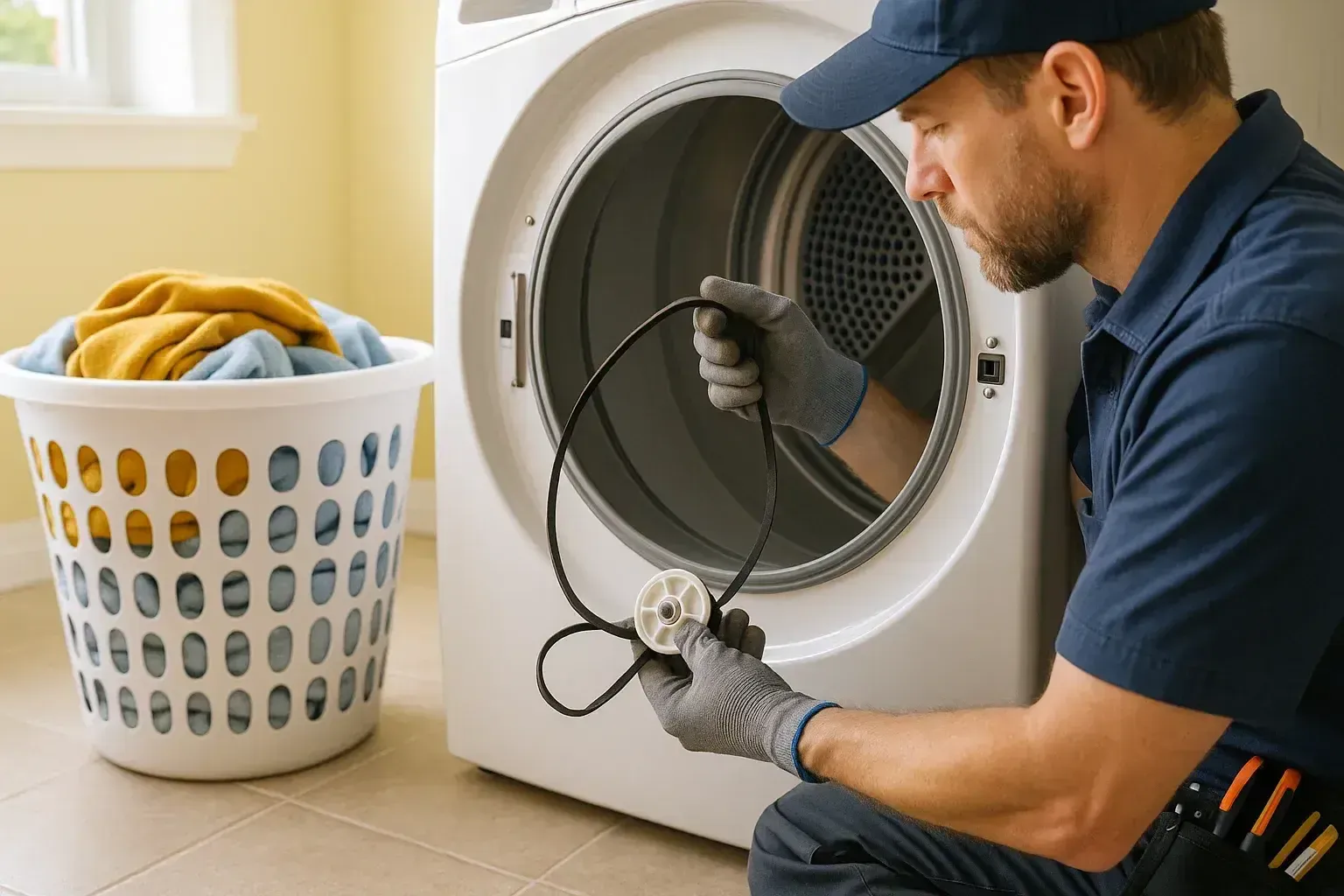
First, check your breaker panel. Electric dryers use a double breaker, and one side may trip without flipping the whole switch. The display might light up, but the dryer won’t work properly. Reset the breaker and try again.
If the breaker is fine, check the door switch. Dryers drum won’t run with the door open, and the switch often fails. This fix is simple and inexpensive. Firmly press the door and try the start button again to make sure the latch works.
A broken start switch or a failed thermal fuse can also keep the dryer from starting. Control board failures are rare, but possible, especially in Electrolux and Amana dryers. A bad control board needs professional diagnosis, as other issues can look similar.
Typical repair cost: Replacing a door switch usually costs $75 to $150. Start switch repairs are similar. Replacing a control board can range from $200 to $400, depending on the model.
This one should not be ignored. If your dryer feels unusually hot to the touch or you notice a burning smell, especially a smell like burning lint or hot plastic, stop the machine immediately.
A severely clogged vent is the most common cause. Blocked airflow builds up heat inside the drum and cabinet. Clothes get very hot, and the dryer reaches unsafe temperatures. Lint in the vent can catch fire.
A stuck heating element is another cause. The cycling thermostat is supposed to control the element. When it fails, the element stays on, overheating clothes and damaging parts.
Lint buildup in the vent is usually the cause of the smell. Heated lint lingers in the system instead of being removed. Stop using the dryer and get the vent inspected before the next use.
For gas dryer owners, a burning smell takes on extra urgency. A blocked or damaged vent on a gas dryer can allow combustion gases, including carbon monoxide, to back up into the home. If anyone in your household is experiencing unexplained headaches or fatigue alongside a burning smell, treat it as an emergency and call a technician immediately.
Typical repair cost: Vent inspection and cleaning usually costs $80 to $180. Cycling thermostat replacement typically runs $100 to $200.
Your dryer starts fine, runs for ten or fifteen minutes, and then stops. You restart it, and the same thing happens. This is one of the more confusing dryer problems because the machine seems to work, just not for long.
Thermal overload is the most frequent explanation. When the dryer overheats, safety components shut the machine down to prevent damage or fire. The dryer cools, resets, and you can start it again, only to overheat again. The root cause is usually a clogged vent, a stuck heating element, or a failing cycling thermostat.
A faulty moisture sensor is another cause. Modern dryers use drum sensors that can become covered with dryer sheet residue and stop working. Clean the sensor bars with rubbing alcohol to fix this; no parts are needed.
Motor overheating is a less common but possible cause. Motors have their own thermal protection, and when they run too hot, usually from a heavy load or restricted airflow, they shut off until they cool down.
Mid-cycle shutoff is always worth investigating before running another load. Using it repeatedly without addressing the root cause can damage internal components or, in a worst case, create a fire risk.
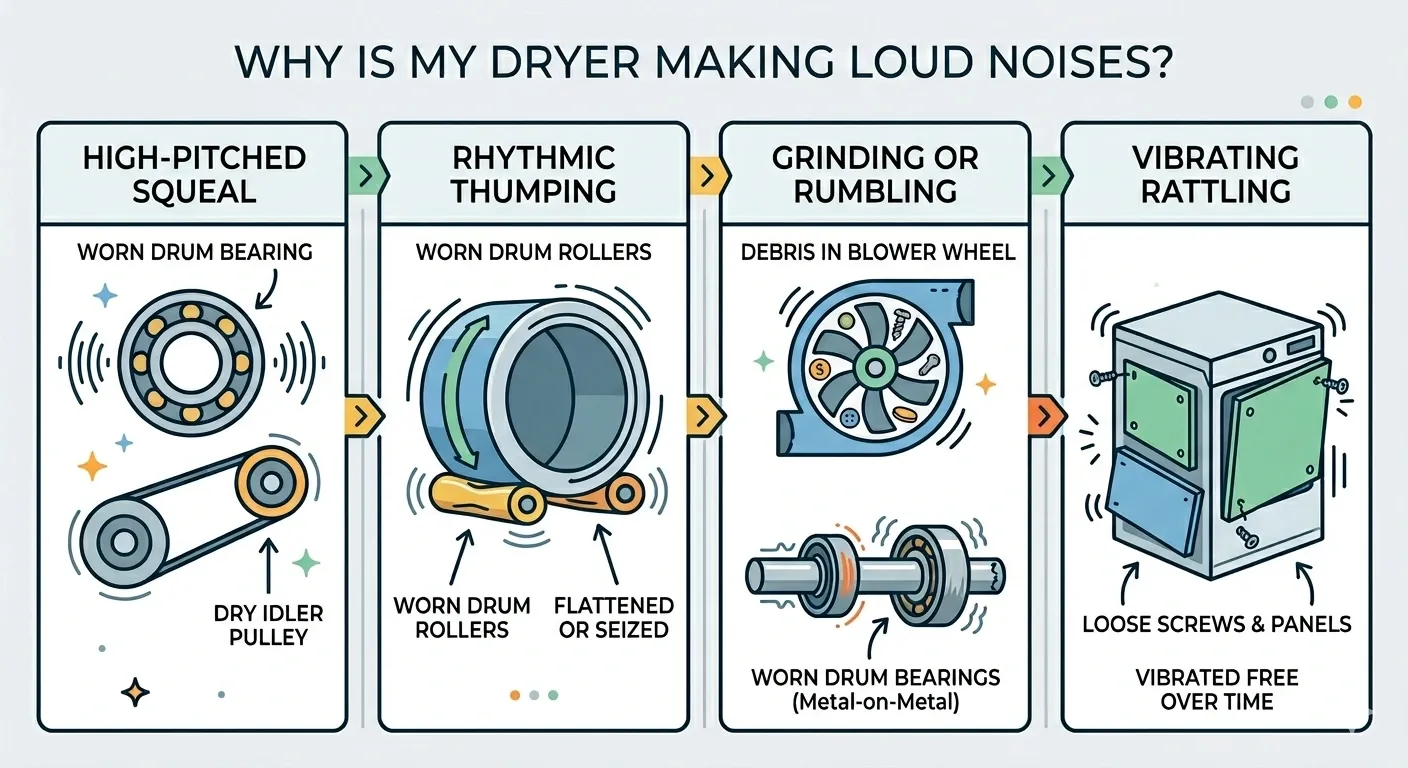
Sometimes you've question in your mind "why is my dryer making loud noise?" Dryers produce some operational sounds, but a new, increasing, or rhythmic noise during drum rotation usually indicates a specific component is failing.
• A high-pitched squeal most often indicates a worn drum bearing or a dry idler pulley. These components allow the drum to rotate smoothly. When they wear out, friction produces an audible squeak that worsens under load.
• A thumping noise that pulses with the drum usually means worn drum rollers. When the rollers flatten or seize, the drum bounces slightly with each rotation. It starts subtly and gets louder over the weeks.
• A grinding or rumbling sound often indicates debris in the blower wheel, such as a coin, button, or small fastener that made it past the lint screen. In more serious cases, it can mean the drum bearings have worn down to a point where metal is contacting metal.
• A rattling that seems to come from everywhere at once is often due to loose screws or a panel that's vibrated free over time. It's worth checking before assuming an internal component is failing.
Typical repair cost: Drum bearing or idler pulley repair runs $100 to $200. Blower wheel cleaning or replacement is usually $100 to $180.
The dryer runs, you can hear it, the drum turns, but your clothes come out cold and still damp after a full cycle. The cause depends on whether you have an electric or gas dryer.
Electric dryers most often lose heat from a blown thermal fuse or a burned-out heating element. The thermal fuse is a small safety device that trips when the dryer overheats, typically due to a clogged vent. Once it blows, the dryer loses heat entirely. Replacing the fuse without cleaning the vent will cause it to blow again. A burned-out heating element produces the same symptom and is common in older machines or models running multiple loads daily.
A failed high-limit thermostat or a worn cycling thermostat can also cut off heat if it no longer accurately reads drum temperature.
Gas dryers have a different setup. Instead of a heating element, they rely on an igniter and a set of gas valve coils to light the burner. When the igniter weakens or the coils wear out, the burner won't light, and you get a dryer that runs cold. Diagnosing gas igniter and valve coil issues requires checking glow and resistance, which should be handled by a trained technician.
For Sacramento homeowners, both electric and gas dryers are common, depending on the age and setup of the home. If you're unsure which you have, check behind the dryer. A gas dryer will have a flexible gas line connecting to the wall in addition to the power cord.
Typical repair cost: Thermal fuse replacement runs $75 to $150. A heating element replacement is usually $150 to $350. Gas igniter and valve coil repairs typically fall between $100 and $250.
If your dryer is heating but clothes are taking 2 cycles or more to dry, the problem is almost always airflow, though Sacramento's climate adds another variable worth understanding.
Sacramento summers are dry, which generally helps drying performance. But during winter months, valley fog and higher ambient humidity mean that moisture-laden air has less capacity to absorb additional moisture from clothes. On foggy days, drying times can run noticeably longer, even with a perfectly functioning dryer.
That said, most slow-drying problems come from the dryer itself, not the weather. Lint screen clogs are an easy fix; clean it before every load. Vent line buildup is the bigger issue. Most homeowners never clean the ductwork inside the walls, and over months and years, lint builds up to the point where airflow is significantly restricted. In older Sacramento homes with longer or more winding vent runs, particularly when the vent exits through the roof, this happens more quickly.
A partial failure of a heating element can also cause long drying times. The element still works, but isn't producing full heat. The dryer runs warm instead of hot, so clothes take much longer to dry.
Low gas pressure is worth mentioning for gas dryer owners. If other gas appliances in your home are also performing poorly, a gas supply issue could be the shared cause.
Typical repair cost: Vent cleaning runs $80 to $180. A partial heating element repair typically costs $150 to $300.
Homes built before the 1990s often have dryer vent setups that don't meet current safety standards. Flexible plastic or foil accordion ductwork was common in older installations and creates problems that rigid metal ducting simply doesn't. It collapses easily, kinks behind the machine, and traps lint far more readily than smooth rigid duct.
California building code now requires rigid metal ductwork for new dryer installations, but many older homes haven't been updated. Beyond material, vent length matters. Code limits most dryer vent runs to 25 feet total, reduced by five feet for every 90-degree elbow. Homes where the dryer is far from an exterior wall, or where the vent exits through the roof, frequently exceed this limit. Every extra foot of ductwork adds resistance, increases drying times, and increases the risk of overheating.
For anyone moving into an older home, having the dryer vent inspected before running a full load is a straightforward precaution.
Most dryer failures are preventable. A small amount of regular maintenance keeps the machine running efficiently and extends its lifespan significantly.
• Clean the lint screen before every load. This is the single most impactful habit. A clogged lint screen restricts airflow, causes longer drying times, and increases heat buildup.
• Clean the vent line annually. Even if the dryer seems to be working fine, lint can accumulate in the ductwork over time. For households running multiple loads per week, twice-yearly cleaning is reasonable.
• Check the exterior vent flap seasonally. Go outside and confirm the flap opens freely when the dryer is running. Birds sometimes nest inside. Debris gets pushed in by the wind. A blocked flap traps heat and moisture inside.
• Wipe down moisture sensor bars every few months. Use rubbing alcohol on a soft cloth to remove dryer sheet residue. Coated sensors misread moisture and cause short cycles or over-drying.
• Don't overload the drum. Running the dryer at full capacity consistently puts extra strain on the drive belt, drum rollers, and motor. Spreading large loads across two cycles extends the life of those components.
• Listen for new sounds. A squeak or thump that wasn't there six months ago is worth addressing early. Noise-related issues cost less to fix when they're caught before they cause secondary damage.
If your washer is also showing signs of wear, catching those problems early follows the same logic. Our washing machine repair service in Sacramento handles everything from spin-cycle failures to water drainage issues, so your entire laundry setup keeps running without interruption.
Modern dryers display error codes when something goes wrong. Knowing what your code means helps you describe the problem accurately and sets expectations before the technician arrives.
Samsung dryer error codes: d80, d90, and d95 indicate a vent blockage at 80%, 90%, and 95% restriction levels, respectively. Don't keep running the dryer. Clean the vent immediately. hE or hC signals a heating error, usually the heating element or thermistor. tS or tC indicates a temperature sensor fault.
LG dryer error codes: d80, d90, d95 carry the same vent restriction warnings as Samsung. TS points to a thermistor failure. HC or HE signals a heating circuit fault. PF indicates a power failure during a cycle.
Whirlpool and Maytag dryer error codes: F01 signals control board failure. F22 points to an outlet thermistor fault. F26 indicates motor relay failure. F28 and F29 relate to issues with the moisture sensor circuit.
GE dryer error codes: E1 or E2 indicate temperature sensor issues. E61 signals a heating element fault.
If your dryer is displaying a code not listed here, note the exact code and brand before calling a technician. It saves diagnostic time and, in some cases, allows the technician to bring the right part on the first visit.
Our technicians are factory-trained and experienced with every major brand listed above and more.
Vent cleaning is one of the most important, yet most skipped, maintenance tasks for any dryer owner. According to the National Fire Protection Association, dryers cause approximately 15,000 house fires in the United States each year, with a fire occurring roughly every 37 minutes. The leading cause is failure to clean the dryer vent.
For Sacramento homeowners specifically, the combination of dry summers and homes with longer vent runs makes this even more relevant. Lint is highly flammable, and a packed vent line creates the exact conditions for a fire to start.
Here's how to approach a basic vent cleaning. Start by pulling the dryer away from the wall and disconnecting the vent hose from the back of the dryer. Use a dryer vent cleaning brush, available at any hardware store, to push lint out from both ends of the hose. Go outside and check that the exterior flap opens freely. If there's a bird nest or debris inside, clear it out.
For ducts in walls, a flexible brush kit works for short runs. For longer or winding vents, use a professional cleaning service. Clean vents once a year if you do frequent laundry.
A dryer under eight years old with a single failed part, like a belt, fuse, or thermostat, is usually worth fixing. Repairs cost far less than a new machine, and the rest of the dryer probably has good life left.
Most dryers last 10 to 13 years. If repairs to an old dryer cost more than half the price of a new one, it may be time to replace it. A good technician can advise what else may need attention soon.
Age is not everything. Fix a 10-year-old dryer with a broken belt. But replacing a 7-year-old dryer that needs both a new motor and a control board is a tougher decision.
A few questions worth asking before you decide: How old is the machine, and what's the remaining expected lifespan? Is this a single-part failure, or are multiple components showing wear? What's the repair cost compared to a comparable new or refurbished machine? Has this machine had other repairs in the last two years?
If repair costs less than 50% of a new machine and the dryer is under 10 years old, repair is usually the right choice.
Before booking a service call, run through these simple checks. They take five minutes and occasionally reveal a fix that doesn't need a technician at all.
Check your breaker panel and reset the breaker, then try again. Clean the lint screen, as a clogged one is one of the most overlooked causes of poor drying performance. Inspect the exterior vent flap and confirm it opens freely when the dryer is running. Check your door latch by pressing it firmly and trying the start button again. Test airflow manually by putting your hand near the exterior vent opening while the dryer is running. If the airflow feels weak or barely present, the vent is likely the culprit.
If your dryer is giving you trouble, you don't have to figure it out alone. Fair Appliance Repair Service has completed over 4,000 repairs in Sacramento and the surrounding area, with more than 1,000 verified five-star reviews from real local customers. Every technician is licensed, certified, and insured, and they carry OEM parts on every truck, so most repairs get done in a single visit.
We offer same-day and next-day appointments, a diagnostic fee that's waived when you move forward with our dryer repair service, and a warranty of 90 days to one full year on parts and labor. There are no hidden fees, and you get a clear quote before any work begins.
Whether it's a gas dryer, electric dryer, or a stacked unit, and whether you are in Elk Grove, Roseville, Carmichael, Citrus Heights, Davis, or anywhere in the greater area, the team is ready to help.
If you'd rather skip the guesswork and get a professional diagnosis right away, our dedicated dryer repair service in Sacramento covers all major brands and dryer types, with same-day appointments available.
Call (916) 333-8388 to schedule your same-day appointment.
Generally, yes. If a machine is over 12 years old and needs an expensive repair, such as a motor or control board, the math often favors replacement. But age alone is not the answer. A 10-year-old dryer with a broken belt is still worth fixing.
Lint buildup in the vent line is the most common cause. The smell comes from lint being heated repeatedly rather than expelled. Stop using the dryer and have the vent inspected before running another load.
They tend to need more maintenance, particularly keeping the condenser clean, but they're not inherently unreliable. Most issues come from skipped maintenance rather than design flaws.
Put your hand near the exterior vent opening while the dryer is running. If the airflow feels weak or barely present, the vent is likely the culprit. If airflow is strong but clothes still are not drying, the issue is likely internal.
It can be. Most modern dryers are designed to shut down when internal temperatures reach dangerous levels. If your machine is cutting power before the clothes are dry, it is likely a "thermal overload" response. Ignoring this warning and repeatedly restarting the machine can lead to a blown thermal fuse or, more dangerously, igniting trapped lint within the cabinet.
Most qualified technicians work on all major brands: Whirlpool, Maytag, Samsung, LG, GE, Kenmore, Frigidaire, Electrolux, Amana, and more.


